

Open Access
Published: October 2026
Licence: CC BY-NC-4.0
Issue: Vol.21, No.2
Word count: 1,802
About the reviewer
Cite this reviewJuric, K. (2026). Integrating Art Therapy Approaches in School Counselling, by Leslie de Vera Arroyo. JoCAT, 21(2). https://www.jocat-online.org/r-26-juric
Book review
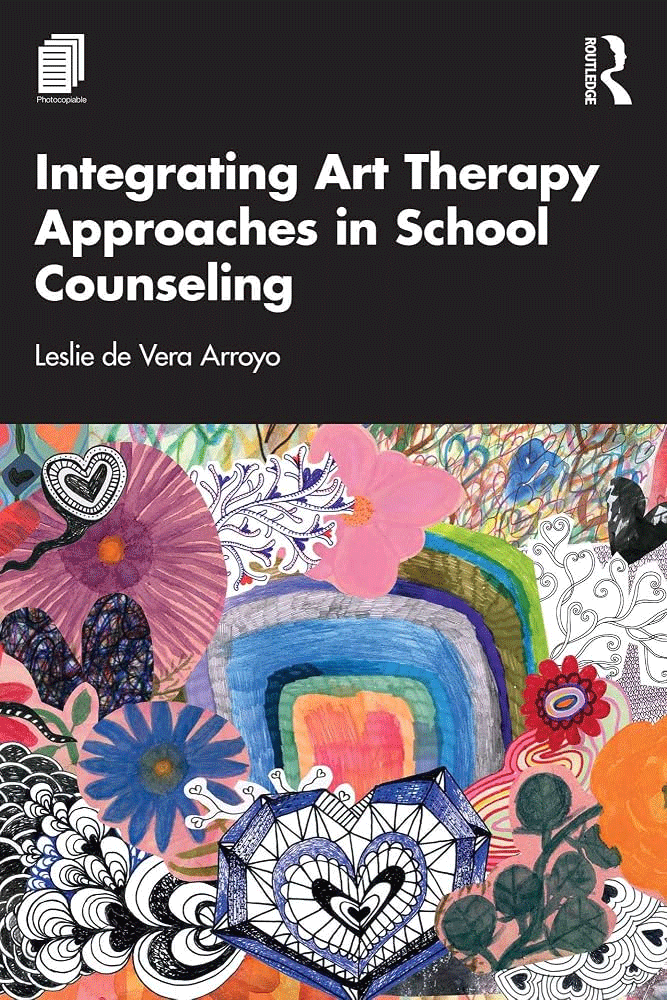
Integrating Art Therapy Approaches in School Counselling, by Leslie de Vera Arroyo
Publisher: Routledge
Published: 2026
ISBN: 978-1-032-55492-1
Reviewed by Kanling Juric
Introduction
Integrating Art Therapy Approaches in School Counselling provides a comprehensive and practical roadmap for school counsellors to incorporate art therapy informed practices in counselling, with the goal “to maximise the impact of school counselling services” (Arroyo, 2026, p.14). Combining Arroyo’s expertise and experience in art therapy and school counselling, the book offers a fine balance between theories and applications through the lens of the United States’ education system.
Book overview
Part I of the book paints the backdrop for art therapy practices in school settings by providing the theoretical foundation of the art therapy discipline (Chapter 1); as well as articulating art therapy’s alignment with the American School Counsellor Association (ASCA) Ethical Standards (Chapter 2); and the ASCA Student Standards (Chapter 3). By anchoring art therapy within evidence-based research and established standards, the author demystifies the discipline through a systematic and accessible approach, providing readers with a structured framework for linking clinical decisions and interventions to established theoretical and professional foundations.
In Part II, the author provides scaffolded, principle-based, and practical implementation guidance targeted at school counsellors. This section first addresses the logistical aspects of art therapy regarding space, materials, and art making (Chapter 4); followed by unpacking the complexities relating to accompanying, supporting, and witnessing art making in school counselling (Chapter 5). Arroyo further highlights how art therapy can be used to support both professional development and reflexive practice for counsellors, while deepening their appreciation and understanding of integrating art into their counselling services (Chapter 6). The book concludes with suggested session plans that integrate therapeutic goals, intervention outlines, and data collection plans, offering practical guidance while reinforcing a data-informed approach to evaluating intervention effectiveness (Appendix).
Terminologies
Terminologies such as “art therapy-based techniques” and “art therapy approaches” (e.g. Arroyo, 2026, p.2) are used interchangeably throughout the book to describe art therapy informed counselling practices. As Arroyo acknowledges at the outset, professional art therapists undergo specialised graduate-level education and clinical training. It is important to highlight that art therapy is a discipline and not a modality. As such, this review will distinguish between ‘art therapy’ as a mental health profession which should be practiced by qualified art therapists, and ‘art therapy-informed’ techniques or practices adopted by school counsellors. This review defines the latter as using art-based approaches informed by art therapy theories and practices in the context of school counselling.
Critical evaluation
Theoretical foundations
Art therapy informed practices described in the book are grounded in various counselling approaches and theoretical orientations, including solution-focused brief therapy, Adlerian, person-centred, cognitive behavioural theory, and mindfulness-based approaches (Chapter 4). This enables school counsellors to implement art therapy informed techniques in line with their own training and expertise, and to adapt therapeutic approaches based on the students’ needs. Case examples and intervention directives are thoughtfully interwoven with the aforementioned theoretical approaches, fostering both intentionality and clinical rigour in the use of art making in school counselling. For instance, the author identifies circumstances when a person-centred approach may be more suitable than a solution-focused approach to foster safety and connection, prevent further overwhelm, and promote agency.
In addition to counselling and psychotherapy theories, Arroyo deepens readers’ understanding of art therapy by opening the book with a concise and meaningful overview of the discipline’s evolution, pioneering figures, applied settings and populations, as well as alignment with contemporary neuroscience research. Such narrative allows the readers to understand the rationales behind art therapy interventions, instead of treating the suggested approaches and session plans as strict protocols. Considerations relating to art materials, structure versus fluidity, art making process and artwork, and therapeutic spaces are explored. This further distinguishes art therapy from art and craft activities, while allowing the readers to critically reflect on their clinical reasonings substantiating the adoption of art-based interventions.
Implementation in practice
Building on theoretical approaches practised within schools, the versatility of art therapy informed interventions is highlighted within the Multi-Tiered, Multi-Domain Systems of Support (MTMDSS) (Hatch, 2024). For example, at Tier 1 art can facilitate externalisation and strengthen confidence; at Tier 2 art can enable focused intervention while fostering connection among small groups; and at Tier 3 art can offer one-on-one support to establish trust and safety. Regardless of the tier of support, the author emphasises the importance of ensuring clarity of therapeutic goals, and alignment with the mindsets and/or behaviours within the ASCA Student Standard such as “sense of acceptance” (ASCA, 2021).
Existing research on school-based art therapy practices primarily focuses on evaluation of specific programs and demonstration of social, emotional and behavioural outcomes (e.g. Bokoch & Hass-Cohen, 2021; Cortina & Fazel, 2015; McDonald et al., 2019; Regev, 2022; Snir, 2022). Arroyo’s text extends the current literature by rendering the complex and multifaceted nature of art therapy accessible through practical guidelines situated within an educational context. The author successfully balances clarity and depth, presenting a structured framework that supports understanding while grounding practice in theoretical rationales and principles that foster critical engagement and professional judgement. The session plans articulate topics and objectives, suggest age groups, group sizes, a structure, prompts, and alternatives to facilitate and summarise the session. Arroyo further highlights the importance for school counsellors to avoid treating the plans in a prescriptive manner but rather apply their own professional judgement to best support the students. The text also includes data collection plans to support clinical reasoning and evaluate outcomes. These include participation data, pre/post assessment items, outcomes, and follow-up procedures. Taken together, the practical guidance offers both context and flexibility, while placing the implementation accountability on the practitioners to adapt in line with the therapeutic objectives and the students’ needs.
Equitable, safe and ethical practices
The principle of educational equity serves as a unifying thread throughout the book. Arroyo is committed to enhancing the accessibility and impact of school counselling to meet the diverse needs of students. The accessibility of art-making is seen in its capacity for non-verbal expression, which encourages participation of students with different communication preferences and cognitive capacities. Through a social justice lens, the author explores the heterogeneity of students and acknowledges that while art cannot resolve all challenges, it provides a pathway that promotes equitable access to education. Moreover, a system-based view is evident in the conceptualisation of students as a part of their “whole ecosystem” (Arroyo, 2026, p.30), through which art is positioned to instil confidence and cultivate resilience.
The author delineates the boundaries between adopting art therapy informed practices in school counselling from clinical therapy. According to Arroyo (2026, p.96), school counselling offers well-being support that focuses “social-emotional, academic, and career” needs. School counsellors may refer students to suitable services requiring additional specialised therapeutic support beyond the school boundary (e.g. mental health diagnosis, significant trauma). Clarification of the scope of practice strengthens counsellors’ capacity to maintain professional accountability and ethical decision-making. However, further distinction between school-based art therapists and school counsellors using art therapy informed techniques is not addressed in the text. This silence presents a gap on the risks and ethical considerations associated with non-art therapists facilitating art therapy. Thus, further clarification of the scope of practice of school counsellors using art-based techniques in line with their professional training and competence is needed.
Culturally responsive and trauma-informed approaches underpin the theories and practices described in the book. The author methodically presents considerations regarding how to incorporate art in counselling in a safe and ethical manner. Clinical guidance is provided regarding establishing a therapeutic space, material properties considerations, art making directives, and management of artwork. However, for professional art therapists, depth and understanding of competencies is reached through intensive training at a Master’s level, practical experience, professional development, and clinical supervision. Further questions are raised as to the ethical implications of school counsellors incorporating art therapy-informed approaches when working with students experiencing complex clinical needs.
Limitations
While the text provides a useful guide for school counsellors to integrate art therapy informed techniques in their practice, its central premise risks reducing art therapy to a collection of techniques and directives. In doing so, it inadvertently underrepresents the theoretical depth, clinical complexity, and professional expertise that characterises art therapy as an accredited profession. The potential risks of non-art therapists facilitating art therapy is not explicitly addressed in the text. This is especially critical when working with vulnerable students with complex needs. Moreover, despite the book’s acknowledgment of the limited availability of art therapists within many United States school districts, the framing of art therapy informed practices as a set of approaches for school counsellors further blurs the distinction between the professions. Consequently, this may limit broader recognition of art therapy as a distinct mental health profession, and hamper opportunities for the profession to be more integrated in schools to support student well-being.
Additionally, despite briefly addressing the implementation of art therapy in education settings in Israel, the text is primarily centred around the United States’ education system and the relevant supporting standards. The focused lens enabled the author to provide contextualised and relevant guidance for United States based school counsellors. However, opportunities remain for more international explorations of school-based art therapy practices and their diverse cultural and systemic contexts. For example, many session plans appear to be individual-focused and outcome driven (e.g. career goals), which may require adaptation in collectivist cultures. Notwithstanding its United States centric perspective, the author’s conceptual framework can be applied to other geographical contexts when accompanied by appropriate culturally responsive adaptations.
Conclusion
Overall, the Integrating Art Therapy Approaches in School Counselling made several key contributions to the literature. Firstly, for school counsellors, the text offers a concise, well-structured, and accessible framework for integrating art therapy informed techniques in school counselling. Grounded in relevant theoretical frameworks, practical implementation considerations and guidance are provided to support intentional, ethical, and equitable practices. Secondly, for early career art therapists or art therapy trainees working in the school system, the book provides useful and tangible examples on how to implement art therapy capabilities in schools. Thirdly, despite the United States focused nature and the school counselling centric lens, the book offers numerous principle-based conceptual frameworks on art therapy practices in schools, which can be adapted by school-based art therapists across the globe.
In spite of these contributions, by presenting art therapy as approaches and techniques for school counsellors weakens the distinctive value and contribution of the art therapy discipline. The delineation between school-based art therapists and school counsellors who utilise art-based interventions remains unaddressed, particularly in relation to scope of practice, professional competencies, and the ethical and safe use of art therapy interventions within therapeutic work. Nevertheless, the book fulfils its intended objective of equipping school counsellors with art therapy-informed approaches for use in school-based practice, and demonstrates the value of leveraging art to enhance student well-being.
References
American School Counselor Association (2021). ASCA student standards: Mindsets and behaviors for student success. American School Counselor Association.
Arroyo, L.D.V. (2026). Integrating art therapy approaches in school counselling. Routledge.
Bokoch, R., & Hass-Cohen, N. (2021). Effectiveness of a school-based mindfulness and art therapy group program. Art Therapy, 38(3), 117–126. https://doi.org/10.1080/07421656.2020.1807876
Cortina, M.A., & Fazel, M. (2015). The Art Room: An evaluation of a targeted school-based group intervention for students with emotional and behavioural difficulties. The Arts in Psychotherapy, 42, 35–40. https://doi.org/10.1016/j.aip.2014.12.003
Hatch, T. (2024). Multi-tiered, multi-domain system of supports. Hatching Results. https://www.hatchingresults.com/blog/2017/3/multi-tiered-multi-domain-system-of-supports-by-trish-hatch-phd
McDonald, A., Holttum, S., & Drey, N.S. (2019). Primary-school-based art therapy: Exploratory study of changes in children’s social, emotional and mental health. International Journal of Art Therapy, 24(3), 125–138. https://doi.org/10.1080/17454832.2019.1634115
Regev, D. (2022). A process-outcome study of school-based art therapy. International Journal of Art Therapy, 27(1), 17–25.
https://doi.org/10.1080/17454832.2021.1957960
Snir, S. (2022). Artmaking in elementary school art therapy: Associations with pre-treatment behavioral problems and therapy outcomes. Children, 9(9), Article e1277. https://doi.org/10.3390/children9091277
Reviewer
Kanling Juric
MAT, Grad Dip Psych, AThR
Kanling is a person-centred, trauma-informed art therapist and Founder of Cerulean Space Art Therapy, a Melbourne-based private practice supporting children, adolescents, and adults. With experience working within a multidisciplinary allied health team in a primary school, Kanling has witnessed the transformative role art therapy can play in fostering student well-being. She continues to collaborate with various schools to design and deliver tailored art therapy programs to meet the needs of the student cohorts. Kanling also convenes the Art Therapy in Schools Community of Practice, connecting, supporting, and advocating for school-based art therapists across Australia, New Zealand, and Asia-Pacific.
Email: kanling.juric@ceruleanspace.com.au