

Open Access
Published: July 2026
Licence: CC BY-NC-4.0
Issue: Vol.21, No.1
Word count: 686
About the author
Polyphony through the screen: A collective narrative screenplay
Anna M. Szaflarski
Abstract
This creative contribution is an excerpt from the screenplay Reconnecting through the Elements, which is a component of an arts-based research project within a larger study examining the benefits of virtual art therapy groups for adults living with cancer. Drawing on narrative therapy, collective documentation, and post-dramatic theatre, participants’ art-sharing reflections and metaphorical language were transformed into a polyphonic script that preserves anonymity while maintaining the relational texture of participants’ voices. Rather than functioning as a neutral record, the screenplay operates as an imaginative reconstruction of collective experience situated between documentation and performance. Through ambiguity, multiplicity, and aesthetic form, the work repositions clinical documentation as a collaborative and creative practice of knowledge production.
Keywords
Arts-based research, collective documentation, virtual art therapy, psycho-oncology, narrative therapy, group therapy
Cite this creative contributionSzaflarski, A.M. (2026). Polyphony through the screen: A collective narrative screenplay. JoCAT, 21(1). https://www.jocat-online.org/c-26-szaflarski
Introduction
Over the course of eight weeks, a different set of characters met. They included weather systems, light sources, plants, songs, galactic objects, and comforting foods. They gathered via Zoom windows to create artwork, discuss illness, relationships, daily challenges and survival, and to witness and support one another. Their names shifted each session, creating the illusion that new characters arrived each session while a relational familiarity accumulated. A squirrel did not return, but instead, grunge music arrived. A campfire’s absence was filled by a knowing orchid. A slow alien ship shared a story about a friendship conflict, while ‘shotgun’ told its trusted cohort of soundtracks how cancer was the hole they had ‘become great friends’ with.
The screenplay (a term used intentionally, as the program itself unfolded on participants’ computer screens via Zoom) emerged, with the consent and collaboration of its participants, from a virtual art therapy group for adults living with cancer and formed part of a larger research study examining the psychosocial experience of virtual art therapy. The study was conducted by this writer in collaboration with the cancer support organisation Gilda’s Club Toronto and was submitted in conformity with the partial fulfilment of the graduate diploma at the Toronto Art Therapy Institute, Canada. In contrast to the pre-program interviews and post-program surveys used in the research, which allowed participants to articulate their individual expectations, concerns, and perceived benefits, the screenplay examined these processes indirectly. The therapeutic movement of the group is not conveyed through direct declarations of change, but through resonance, response, and collective witnessing. As characters move fluidly between positions of vulnerability, support, humour, and reflection, relational forms of hope, altruism, and universality begin to emerge between them. Rather than functioning as a transcript, the screenplay reconstructs the group's relational field through metaphor, fragmentation, repetition, and collective witnessing. Participants’ reflections during art-sharing, alongside the metaphorical language generated by weekly icebreaker exercises, were transformed into a polyphonic dramatic text.
The process of creation drew on narrative therapy, collective documentation, arts-based research, and post-dramatic theatre. Narrative practices informed a collaborative, transparent, non-pathologising approach to documentation (White & Epston, 1990), while arts-based research positioned aesthetic form itself as a mode of inquiry rather than illustration (McNiff, 2007). The screenplay structure was further informed by post-dramatic concepts of polyphony and collective presence, in which multiple voices coexist without resolving into a singular narrative authority (Lehmann, 2006).
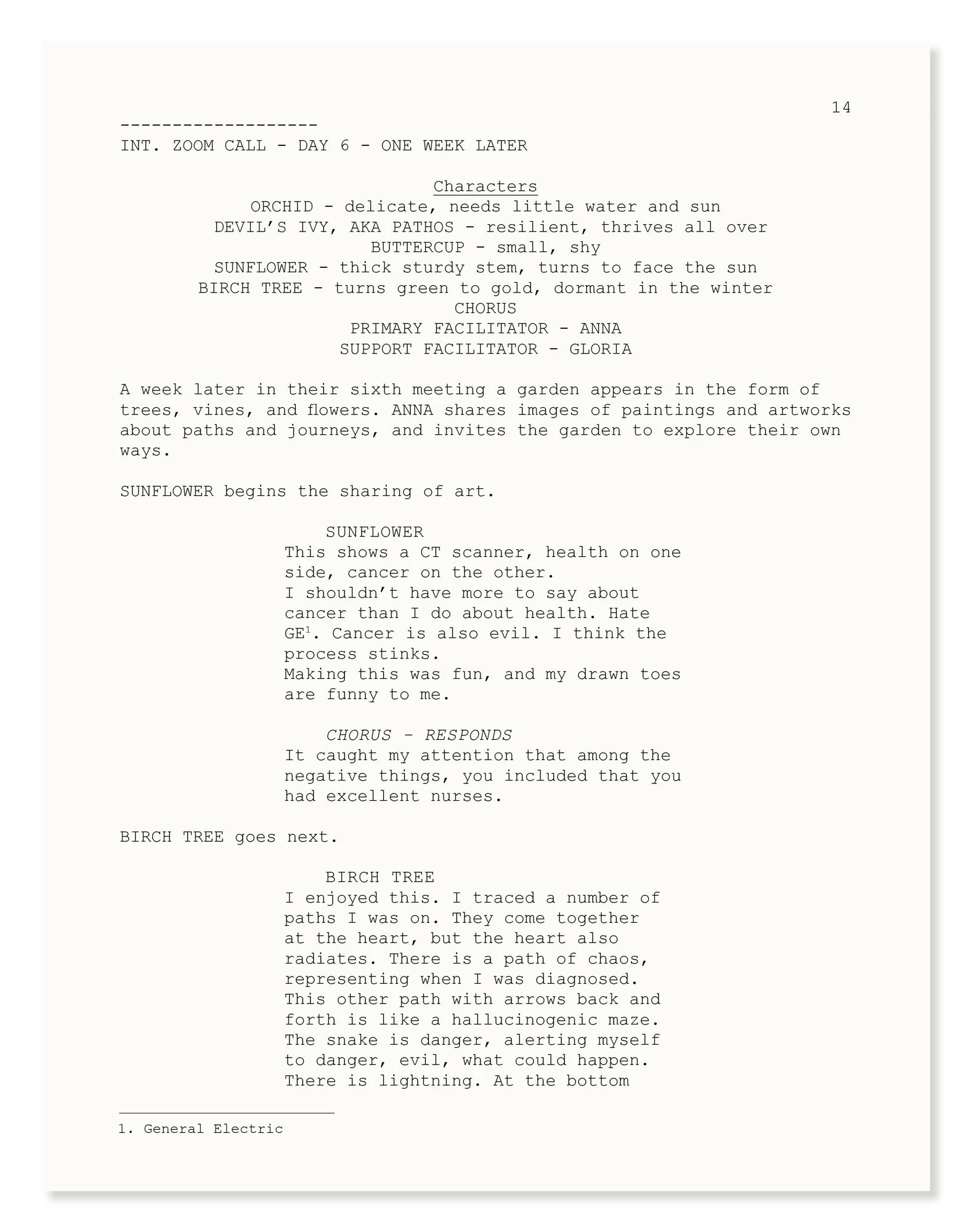
The decision to work in screenplay form emerged gradually through engagement with the session note materials. Earlier attempts at poetic synthesis and collective narrative writing compressed participant voices into a unified ‘we’ (a form used powerfully developed by narrative therapy practitioners such as David Denborough (2008)), subsequently flattening the distinct tonalities, rhythms, and contradictions that characterise the group therapy process. The screenplay offered another possibility: a structure capable of holding simultaneity, fragmentation, interruption, resonance, and return. The recognisable visual language of the screenplay – the courier font, spacing, and characteristic formatting – shifts the text away from record and toward imagination, potential and re-creation.
Participants are not represented in the screenplay through fixed pseudonyms but through metaphorical identities generated during the sessions themselves. One week, participants arrived as weather patterns, another week as sources of light, botanical plants, or soundtracks. These temporary forms became dramaturgical containers that protected anonymity while preserving emotional texture and imaginative specificity. The recurring chorus, which emerges more frequently as familiarity between characters grows, functions not as a singular speaker but as a collective field of witnessing through which encouragement, humour, reframing, grief, and recognition circulate among participants.
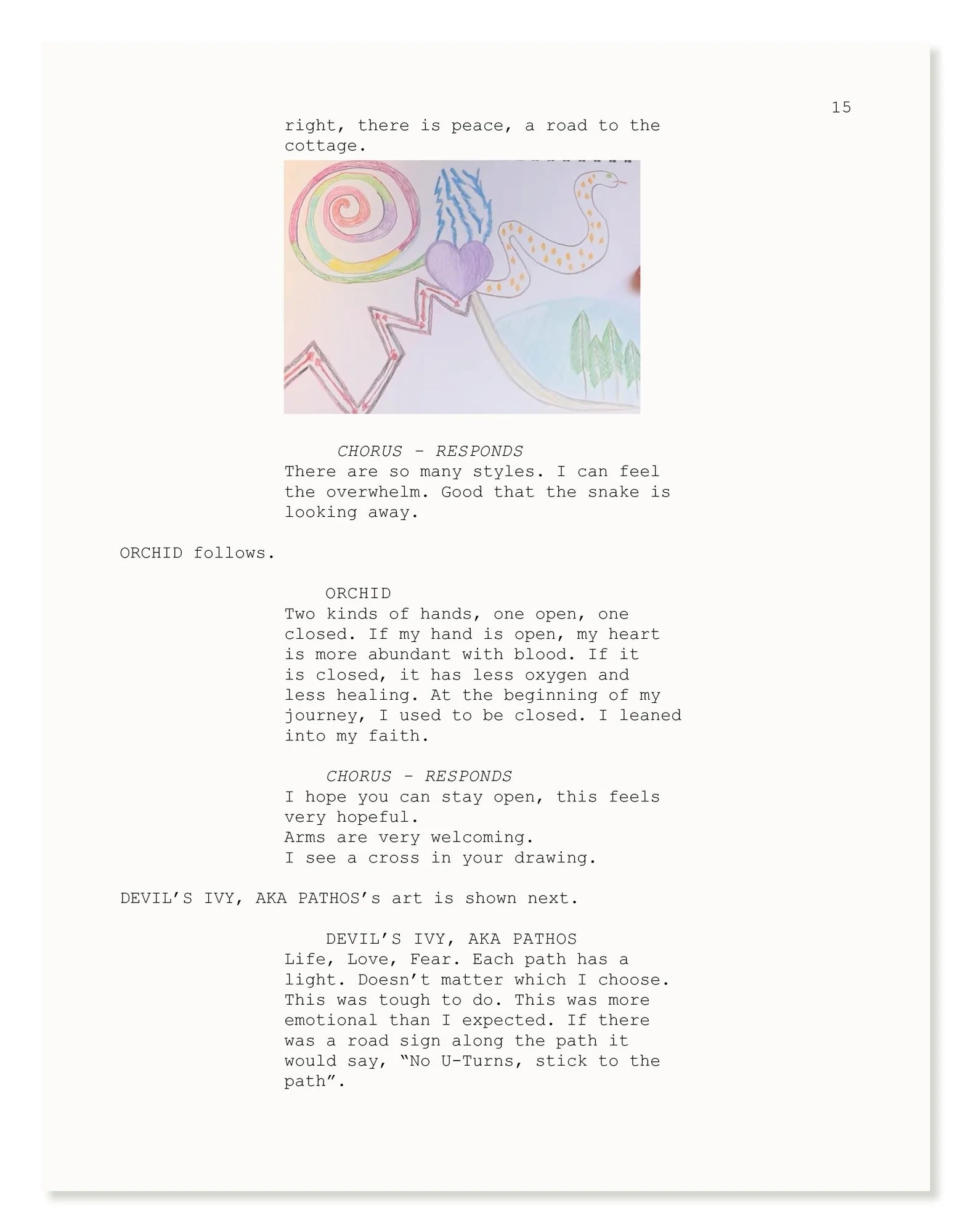
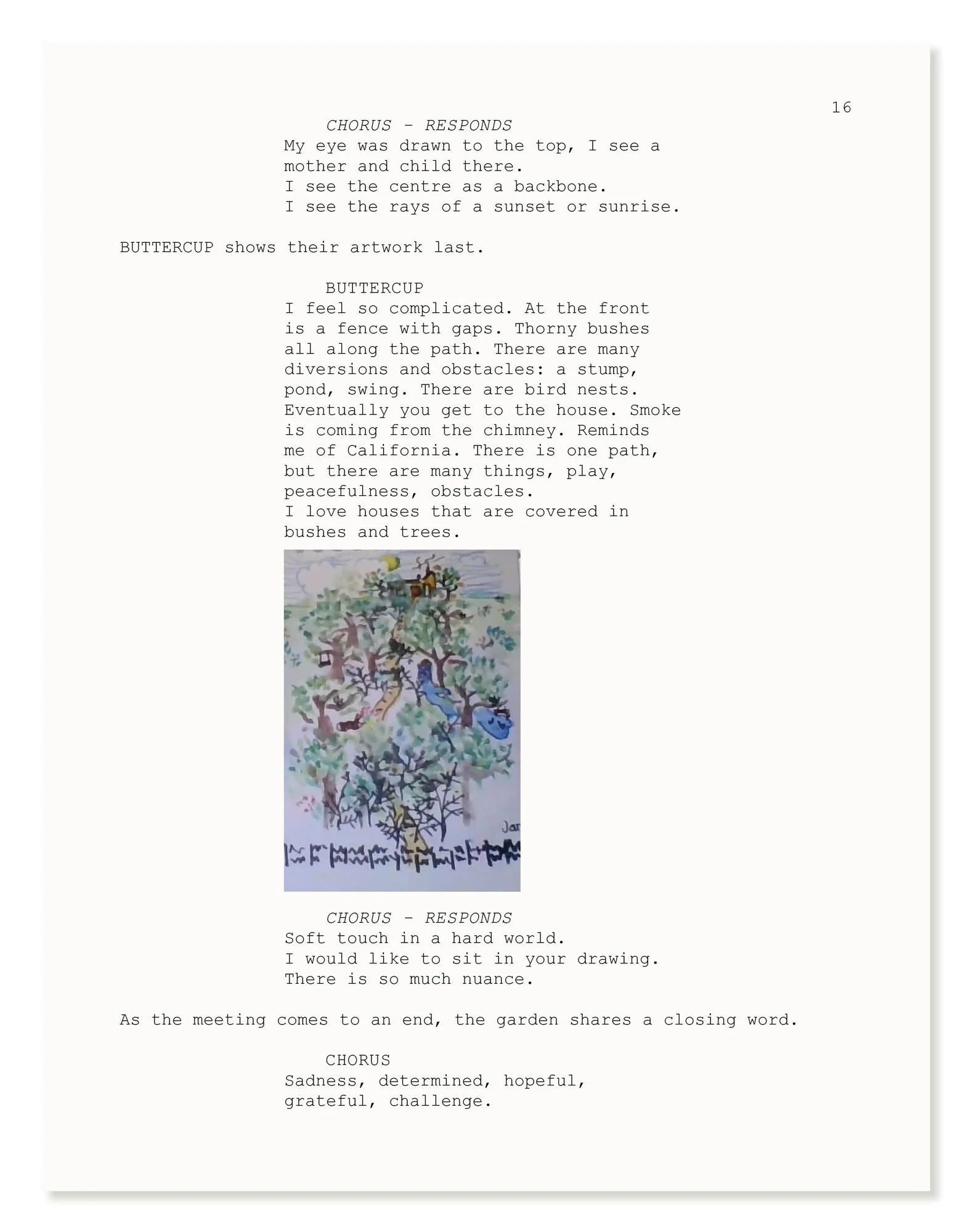
Selected screenshots of participants’ artworks are interspersed throughout the screenplay, though not every image from the program is included. The play, therefore, moves between visual traces of participants’ creations and the reader’s imaginative reconstruction, further fragmenting the piece's temporality and continuity.
What follows is not an excerpt from a clinical record, but a collective document situated somewhere between testimony, performance, memory, and dream. It is neither a transcript nor fiction, but a polyphonic reconstruction of the relational textures of the group therapy experience, gesturing toward the ways in which support, meaning, and connection emerge within the shared experience of illness.
Above:
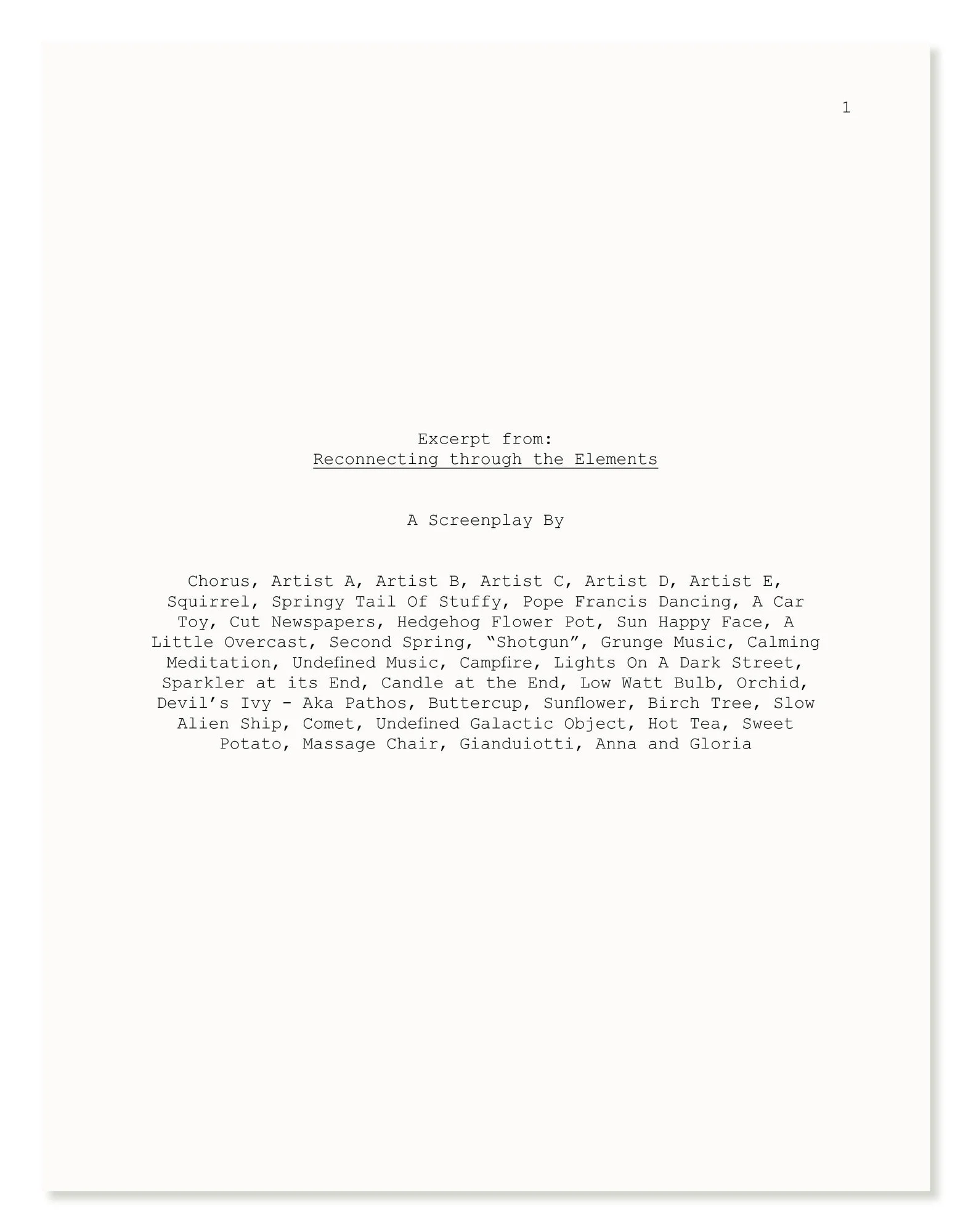
Figure 1. Title page of Reconnecting through the Elements collective narrative screenplay, 2026.
Figure 2. Page 14 of Reconnecting through the Elements collective narrative screenplay, 2026.
Figure 3. Page 15 of Reconnecting through the Elements collective narrative screenplay, 2026.
Figure 4. Page 16 of Reconnecting through the Elements collective narrative screenplay, 2026.
Endnote
All notes and images included in this contribution were used with the informed and explicit consent of participants. This arts-based research component formed part of the major research project The Benefits of Virtual Art Therapy Groups for Adults Living with Cancer (Anna M. Szaflarski, 2026), which received ethics approval from the Toronto Art Therapy Institute (TATI), Canada. The TATI Research Ethics Committee reviews all research involving human participants in accordance with established ethical standards. TATI is an approved training program of the Canadian Art Therapy Association (CATA).
Acknowledgements
This work emerges from, and is dedicated to, the individuals living with cancer whom I have had the privilege to work alongside. Your creativity, generosity, and willingness to share your stories continue to shape my understanding of art therapy and of what it means to accompany others through illness.
Gratitude is also extended to the programming team at Gilda’s Club Greater Toronto for their support, insight, and encouragement throughout the development of this work.
References
Denborough, D. (2008). Collective narrative practice: Responding to individuals, groups, and communities who have experienced trauma. Dulwich Centre Publications.
Lehmann, H.-T. (2006). Postdramatic theatre. Routledge.
McNiff, S. (2007). Art-based research. In J.G. Knowles & A.L. Cole (Eds.), Handbook of the arts in qualitative research: Perspectives, methodologies, examples, and issues (pp.29–40). Sage.
White, M., & Epston, D. (1990). Narrative means to therapeutic ends. W.W. Norton & Company.
Author
Anna M. Szaflarski
MA, DTATI, RP(Qualifying)
Anna is an art therapist and registered psychotherapist (Qualifying) based in Toronto, Canada. Her clinical work integrates art therapy, narrative therapy, trauma-informed care, and somatic approaches with adults navigating cancer, trauma, chronic pain, and major life transitions. She currently provides psychotherapy in rehabilitation settings and facilitates virtual art therapy groups for adults living with cancer. Szaflarski's research explores how shared creativity can foster meaning-making, connection, and emotional resilience alongside healthcare contexts. Alongside her psychotherapy practice, she maintains an interdisciplinary studio art practice.
email: anna@bluegianttherapy.ca website: https://bluegianttherapy.ca/