

Open Access
Published: September 2025
Issue: Vol.15, No.1
Word count: 539
About the author
Cite this creative contributionGordon-Flower, M. (2015). Moments of soul encounter (unleashed). ANZJAT, 10(1), 78-79. https://www.jocat-online.org/c-15-gordonflower
Moments of soul encounter (unleashed)
Marion Gordon-Flower
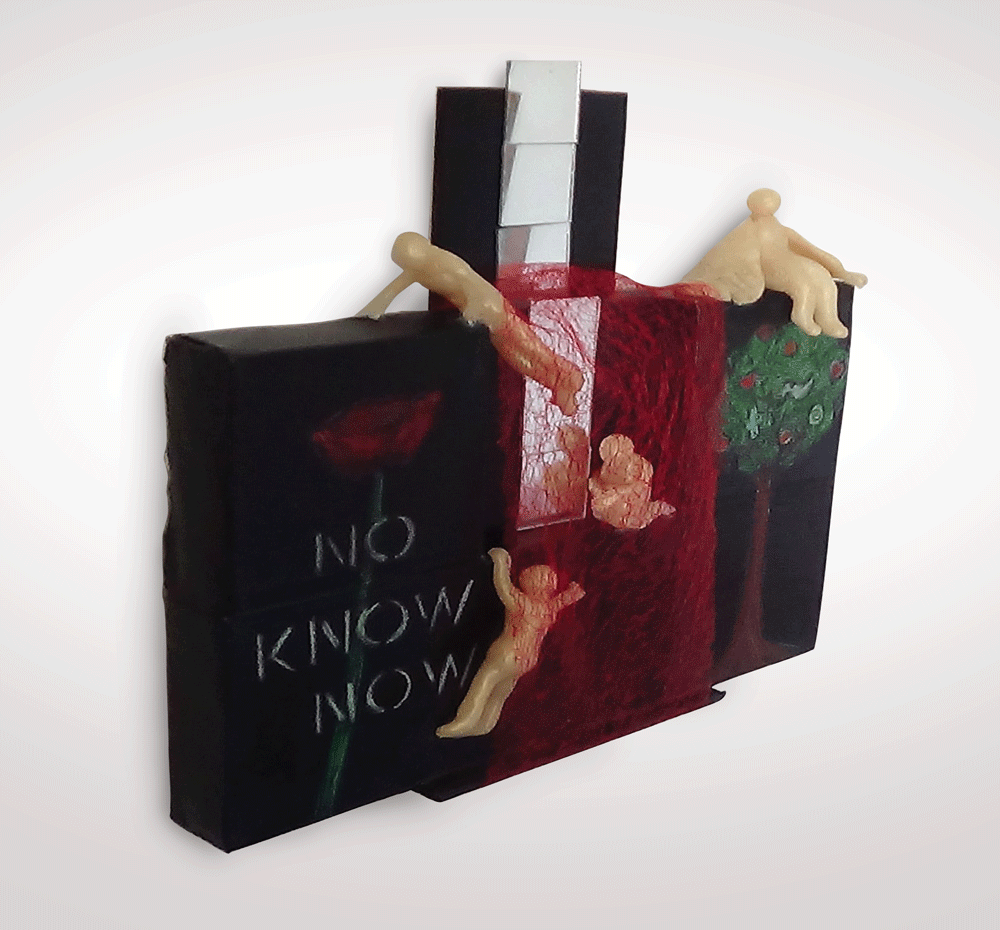
Marion Gordon-Flower, Moments of soul encounter (unleashed), 2015, acrylic, chalk pastel, sculpting medium, hardboard, mirror, varnish and mesh on canvas, 305 × 305 × 60mm.
Creating this artwork proved to be a journey of changes on multiple levels. Initially there was a quest to materialise the forms seen in the mind’s eye, however, engagement with the media required adaptation and negotiation. The idea was the catalyst whilst the media was the life-giver, with the shape and composition emerging as one thing led to another. Metaphors arose along the quick-moving path of reflections, leading to a sense of transformation. As ideas are tested and reformed, so am I.
The quest to aptly title the work formed a parallel process as poignant as the visual exploration. The title began as ‘Woman in transition’, but, as the artwork took form, this no longer described where I was getting to and what I was seeing. The next trial title, ‘Woman in transition transformed’, to me implied ‘fixed and fully formed’ but this was precisely one of the challenges which had led to creating the artwork; arriving at a new but fixed point would be counter-transformational. Another option, ‘Transition story transformed’, seemed too distancing.
The process of creation was unexpected, unpredicted, unleashed. At this stage, the artwork was arriving at a point of resolution, and so was I. However, while the artwork will always remain a record of this resolution moment, I will move on in a continuum of transformation. So the title ‘Resolution moment in transformational journey’ seemed to be getting closer to the mark. However, none of the titles had incorporated the way I had taken the reflections to bed with me, leading to my being awash with tears in the early hours and to new awakenings at daybreak. Nor did these titles suggest the ways that the sculptural forms born of the process had been re-worked through dance, giving rise to freer forms of embodiment. The elements of Te Whare Tapa Whā (the Māori model of health developed by Mason Durie in 1982, and now integrated into New Zealand Ministry of Health policies and practices) came unexpectedly into play.
As I experimented with placement of the sculptural components, the four key domains were spontaneously encountered: the effort of the physical body – tinana kikokiko – in striving to meet demands, the re-focusing of the intellect and calming of emotions – hinengaro – through meditational approaches, and the potential triumph of spirit over circumstances – wairua. I also experienced the emergent forms as being partly personal and partly psychic in connection with family – whānau. The anguish and joys, needs, losses, and gains of family members affect me, sometimes from a distance. I am in the heart of the community around me which is changing and this also affects me.
The word ‘soulfulness’ sprung forth for consideration. Soul implies both the sacred and the poetic, and importantly, being open to the vulnerability of one’s own humanity. Arising from a place of soul, the artwork can speak a language understood by other souls. Naming it is perhaps superfluous to requirements, yet proved a crucial aspect in reaching resolution and therapeutic integration.
I arrived at an entirely different title from the one initially projected onto the process, that of ‘Moments of soul encounter (unleashed)’. Then it was time to move on from the artwork to test out the new wings that it has given me.
Author
Marion Gordon-Flower
MAAT (Clin) Hons, GradDip.Teach, BMA, AThR
Marion has been service manager and arts therapist practitioner in Auckland for a mental health NGO, Māori organisation characterised by diversity, since 2017. She previously worked as an arts therapist for a rehabilitation service for eight years and developed a multimodal arts therapy group programmes for people with physical, developmental and intellectual disabilities. She is a published author with Jessica Kingsley Publishers and ANZJAT and has been a regular presenter at arts therapies conferences in New Zealand, Australia and Singapore. Current areas of interest are in providing multicultural services, working with archetypal approaches including pūrākau, and finding attunement with Papatūānuku.