

Open Access
Published: March 2026
Licence: CC BY-NC-4.0
Issue: Vol.21, No.1
Word count: 897
About the reviewer

Cite this reviewTan, S.M. (2026). Book Review – Art therapy for racial trauma, microaggressions and inequality, by Chioma Anah. JoCAT, 21(1). https://www.jocat-online.org/r-25-tan
Book review
Art therapy for racial trauma, Microaggressions and inequality, by Chioma Anah
Publisher: Jessica Kingsley
Published: February 2025
ISBN: 978-1839978333
Reviewed by Su Mei Tan
Overview and theoretical contribution
Art Therapy for Racial Trauma, Microaggressions and Inequality makes a significant contribution to the creative arts therapies literature by addressing the persistent under-examination of race, power, and systemic oppression within therapeutic theory and practice. Dr Chioma Anah positions racial trauma not as an individual pathology, but as a cumulative, relational, and structurally produced phenomenon. This framing challenges dominant Western therapeutic paradigms that have historically individualised distress while obscuring the socio-political contexts in which trauma occurs.
Anah conceptualises racial trauma as embodied, chronic, and shaped by repeated exposure to microaggressions and systemic inequities. These experiences are situated within broader histories of colonisation, enslavement, migration, and racialisation, reinforcing the ethical necessity for therapists to attend to power, context, and historical continuity within clinical encounters. This approach aligns with contemporary trauma theory that recognises trauma as both neurobiological and socially mediated (van der Kolk, 2014), while extending the discourse to explicitly address racialised harm.
Critical race and decolonial perspectives
Drawing on critical race theory and decolonial scholarship, Anah interrogates how racism operates not only in society but also within therapeutic spaces. Concepts such as racialisation, intersectionality, internalised oppression, and whiteness are articulated with conceptual clarity and clinical relevance. This approach echoes Delgado and Stefancic’s (2017) assertion that racism is ordinary and systemic rather than exceptional, and that professional institutions, including therapeutic disciplines, may inadvertently reproduce harm through neutrality, silence, or colour-blind approaches.
A key strength of the text is its emphasis on practitioner reflexivity. Anah invites therapists to examine their own social locations, assumptions, and power within therapeutic relationships. Reflexivity is framed as a foundational ethical responsibility rather than a supplementary skill, particularly when working with clients whose experiences of trauma are inseparable from systemic oppression. This stance reinforces the necessity of ongoing self-examination and accountability in racial trauma work.
Clinical and arts-based practice applications
The text effectively integrates theory with applied practice through the use of clinical vignettes. These examples illuminate how racial trauma and microaggressions may surface within therapy sessions, training environments, and professional settings, including creative arts therapy contexts. The vignettes prioritise moments of rupture, uncertainty, and repair, modelling a therapeutic stance grounded in humility, curiosity, and relational accountability rather than technical mastery.
From a creative arts therapy perspective, Anah offers a nuanced examination of art-making as a therapeutic modality. Art is presented as a means of externalising, witnessing, and transforming experiences of racial trauma, while also carrying the potential to retraumatise if facilitated without cultural attunement and informed consent. Emphasis is placed on client choice, pacing, and culturally situated meaning-making. This careful positioning challenges romanticised assumptions that creativity is inherently healing and instead foregrounds ethical responsibility in arts-based practice. These principles align with trauma-informed expressive arts approaches that emphasise safety, agency, and relational containment (Malchiodi, 2020).
Embodiment and neurobiological perspectives
Anah’s sustained attention to embodiment represents a substantial contribution to the field. Racial trauma is understood as being held somatically, often manifesting through hypervigilance, dissociation, and chronic stress responses. Creative arts therapists are encouraged to attend to bodily cues, sensory experiences, and regulation strategies alongside symbolic expression.
This integrative approach bridges creative arts therapy with neurobiological understandings of trauma (van der Kolk, 2014), while maintaining a critical awareness of socio-cultural and political context. Importantly, Anah avoids reducing racial trauma to a purely biological process. Instead, she emphasises the interdependence of body, environment, and systemic power, offering a holistic framework that resists pathologisation while acknowledging the embodied impacts of racism.
Training, supervision, and organisational contexts
Beyond individual clinical work, the book extends its analysis to training institutions, supervision contexts, and organisational cultures. Anah critiques how systemic racism may be perpetuated through defensiveness, avoidance of difficult dialogue, or performative diversity initiatives. She advocates for sustained education, reflective supervision, and structural accountability within the creative arts therapies and allied professions.
This focus broadens the book’s relevance beyond individual practitioners, positioning racial trauma as an ethical and organisational concern rather than solely a clinical issue. The text challenges institutions to consider how curricula, supervision practices, and professional cultures may either support or undermine anti-racist practice.
Critical appraisal and contextual considerations
While the book is theoretically rigorous and clinically rich, its depth and emotional intensity may feel confronting for readers who are early in their engagement with racial justice and anti-racist practice. Additionally, although Anah’s frameworks are highly transferable, practitioners outside North American contexts may need to undertake further work to explicitly situate the material within their own local socio-historical landscapes.
These considerations, however, do not detract from the book’s contribution. Rather, they reinforce Anah’s central argument that racial trauma work requires sustained reflection, relational accountability, and contextual responsiveness rather than prescriptive techniques or simplified solutions.
Conclusion and local relevance
Art Therapy for Racial Trauma, Microaggressions and Inequality is a timely and important text for creative arts therapists, supervisors, educators, and students committed to ethical and socially responsive practice. Although grounded largely in North American scholarship, the conceptual frameworks offered readily translate to diverse contexts shaped by colonisation, migration, and systemic inequity.
In conclusion, Dr Chioma Anah offers a rigorous, compassionate, and critically engaged contribution that expands the theoretical foundations of creative arts therapy while challenging the field to reckon with its blind spots. The book calls practitioners into deeper reflexivity, ethical responsibility, and relational presence. It is a valuable addition to creative arts therapy scholarship and a recommended text for training, supervision, and professional development contexts.
References
Delgado, R., & Stefancic, J. (2017). Critical race theory: An introduction (3rd ed.). NYU Press.
Malchiodi, C.A. (2020). Trauma and expressive arts therapy: Brain, body, and imagination in the healing process. Guilford Press.
van der Kolk, B. (2014). The body keeps the score: Brain, mind, and body in the healing of trauma. Viking.
About the reviewer
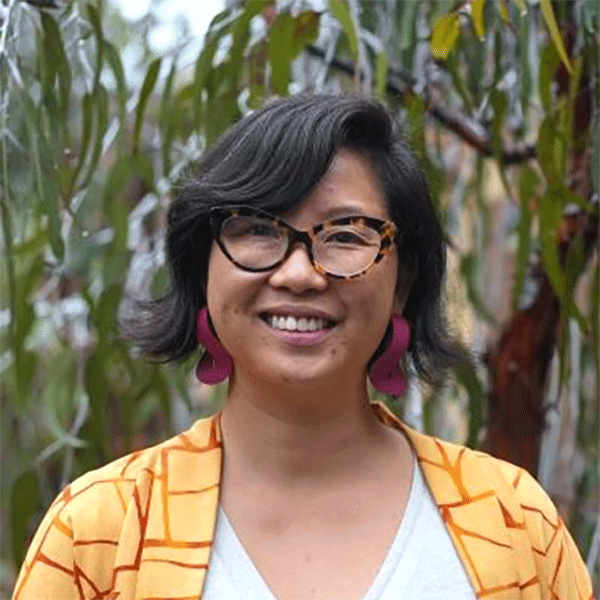
Su Mei Tan
AThR
Su Mei is a creative arts therapist, yoga therapist, clinical supervisor, and practicing artist based between Melbourne and Kuala Lumpur. She is the Founder and Lead Art Therapist of Art Tearapy, a social-enterprise practice providing trauma-informed, culturally responsive creative arts therapy to individuals and communities, with a particular focus on first- and second-generation migrants, refugees, First Nations people, and young people. Su Mei’s interdisciplinary background spans architecture, art therapy, yoga therapy, and socially engaged art practice, informing her interest in collective trauma, embodied approaches, and community-led healing. Her clinical and supervisory work centres ethics, reflexivity, and arts-based inquiry, with a commitment to integrating practice-based knowledge into research and writing.