

Open Access
Published: July 2026
Licence: CC BY-NC-4.0
Issue: Vol.21, No.1
Word count: 2,144
About the reviewer
Exhibition review
Recovering Art
Held at the Dax Centre, Melbourne
Artists:
Abdul Abdullah, Ruth Buchanan, Graeme Doyle, Carla Krijt, Jenna Lee, NEG, Renee Sutton, Luke Willis Thompson, and John Young Zerunge
15 May to 18 December 2026
Reviewed by Sarah Molnar
On an unusually warm Friday evening in May, I entered The Dax Centre within the Florey Institute of Neuroscience and Mental Health to experience Recovering Art, an exhibition examining the complex relationships between artistic expression, psychiatric histories, and institutional archives.
Bringing together more than 40 works, the exhibition places archival material and works from the Cunningham Dax Collection alongside recent works by leading contemporary artists from Australia and Aotearoa New Zealand. Featured artists include Abdul Abdullah, Ruth Buchanan, Graeme Doyle, Carla Krijt, Jenna Lee, NEG, Renee Sutton, Luke Willis Thompson, and John Young Zerunge.
Dr Eric Cunningham Dax was an English psychiatrist appointed Chairman of the Mental Hygiene Authority in Naarm Melbourne in 1952. In this role, he introduced significant reforms to Victoria’s mental health services, including the establishment of art therapy programs within psychiatric hospitals.
When Victoria’s psychiatric hospitals began to close in the 1980s, thousands of artworks produced through these programs were at risk of destruction. Dr Cunningham Dax recognised their educational and clinical value, and salvaged approximately 8000 works. This act formed the foundation of what is now known as the Cunningham Dax Collection.
Recovering Art does not simply revisit historical works; it asks viewers to consider the ethics of looking. For creative arts therapy practitioners, these questions are particularly significant. Who has the authority to interpret another person’s expression, how is consent carried across time, and what responsibilities emerge when personal experiences become part of institutional narratives?
These questions feel particularly significant within the creative arts therapies, where the relationship between maker, artwork, and witness is central. Recovering Art invites a relational encounter, asking viewers to remain curious rather than certain, and to approach each artwork with openness rather than assumption.
Cite this reviewMolnar, S. (2026). Exhibition review – Recovering Art: The Dax Centre. JoCAT, 21(1). https://www.jocat-online.org/r-26-molnar
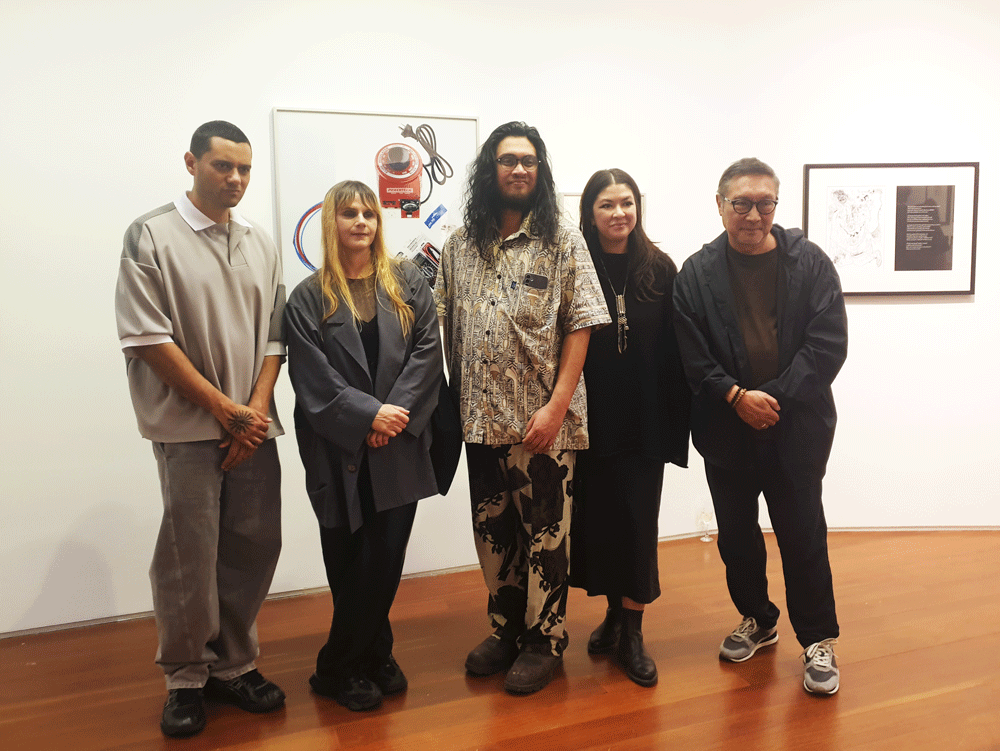
Luke Willis Thompson, Ruth Buchanan, Andy Butler, Jenna Lee, John Young Zerunge
Entering Recovering Art
Welcoming visitors into Recovering Art is A Little Push, from Abdul Abdullah’s Magical Thinking series. Abdullah is undoubtedly one of the major names featured in the exhibition, making his inclusion a significant coup for curator Andy Butler. Following the artist’s Packing Room win at the 2025 Archibald Prize, the work arrives with considerable momentum and visibility for the artist. Abdullah’s practice consistently seeks to renegotiate histories, creating space for alternative possibilities and new conversations around displacement, alienation, and identity (Ames Yavuz, 2026). These concerns resonate strongly with Recovering Art, which sits with the complicated inheritance of patient artworks and raises questions of archive, classification, and the conditions under which institutions look at, hold, and speak for the lives of others. The work also signals the first of several subtle curatorial gestures by Butler that allow humour and lightness to punctuate the exhibition’s heavier themes. Abdullah’s anthropomorphised rock registers the strangeness of how meaning gets read into the world and offers visitors an invitation to enter the exhibition and its deeper reflections.
Abdul Abdullah, A little push, 2023, 1980 × 1620mm.
Time’s Slow Passing series – John Young Zerunge
Time’s Slow Passing #1–8 by Hong Kong-born Australian artist John Young Zerunge is a series of etchings and lithographs on paper created in response to the diary of Jong Ah Siug, an inmate of the Yarra Bend Asylum in the late 19th century. A Chinese miner tried for the crime of malicious wounding, Jong was ultimately not found guilty, yet was committed to the Yarra Bend and Sunbury lunatic asylums, where he remained incarcerated for over 30 years until his death. During this time, he taught himself English and meticulously documented his experiences in a miniature diary featuring detailed maps of his world (Chinese Museum, 2024).
Drawing from Jong’s diary, Young often recreates its pages at the same scale and in reverse. Through the somatic discipline of repetition, Young engages with the rhythms of concentration and endurance that sustained Jong throughout his prolonged incarceration, transforming the act of mark-making into both memorial and embodied gesture, a process that reflects broader understandings of art-making as an embodied and reparative practice within carceral contexts (Tucker & Luetz, 2025).
John Young Zerunge, Time’s Slow Passing #1–8, 2023, etching and lithography on rag paper, 440 × 380mm each.
Return of the Medicated Man – Graeme Doyle
I was delighted to encounter the vibrant works of Graeme Doyle, who lived with schizophrenia and bipolar disorder from the age of 18. A prolific artist, poet, performer, and musician, Doyle has more than 80 works housed within The Dax Centre collection and was the subject of the retrospective exhibition The Medicated Man in 2023–24. In Recovering Art Butler pairs an untitled work with the sharply titled It’s Not a Hangover, it’s a Guillotine Offer Your Head, drawing attention to Doyle’s wit, irreverence, and distinctive ability to balance humour with the darker realities of living with a mental illness.
A reflection by Graeme Doyle sits beside his works:
My work is full of happy misery and funny tragedy. Life is a mixture. Sometimes it ends up a mess, but somehow I don’t drown in it completely and bob to the surface again, give a wave for help, or just to say ‘hello’… Ever seen an unhappy caterpillar? (n.d.)
The quote encapsulates the wit and vulnerability that pulses through Doyle’s practice, where humour becomes inseparable from suffering and survival.
Graeme Doyle, It's Not a Hangover, it's a Gullotine Offer Your Head, undated, digital print of original drawing on paper reworked with ink and correction fluid, poetry, 420 × 290mm.
Who Gets to Tell the Story? – Luke Willis Thompson and the ethics of representation
Luke Willis Thompson, whose work has been exhibited at Tate Britain in London, the New Museum in New York, and documenta 14 (2017) in Kassel, Germany, presents work that engages with the histories of psychiatry, the state, and mental illness. Known for creating works that identify and recover objects that embody inequities of power and crystallise complex moral and ethical questions (Queensland Art Gallery | Gallery of Modern Art, 2026), Thompson is represented by three works, including Untitled, a lithium gelatin print produced using traces of his own psychiatric medication. His practice has generated critical debate around both the themes he engages with and the ethics of representation within his own work (Cascone, 2018), prompting broader questions about who can represent suffering within institutional art spaces, and who benefits from doing so.
Luke Willis Thompson, Self-sovereignty-diagnosis, 2026, digital print, 850 × 850mm.
Works by Renee Sutton, Untitled #1-8, 1959, gouache on paper, 330 × 420mm each.
Record of Institutional Life – Renee Sutton
“Renee Sutton was the only artist from the Cunningham Dax Collection whose permission we were able to obtain,” noted the curator, a statement that landed heavily between us during a brief conversation across the room from Sutton’s work. The comment underscored the ethical complexities surrounding the exhibition of historical patient artworks. Butler spoke of approaching the wider collection with a deep sense of caution and responsibility, conscious that many of the works were created by artists who may never have intended their deeply personal expressions to be publicly viewed.
Earlier that evening, while viewing Sutton’s work, I struck up a conversation with a woman standing beside me, who shared her own connection to the former Larundel psychiatric hospital where Sutton had resided in the late 1950s. As she spoke, I could see the memory return vividly in her expression, recalling going there as a child to visit a relative. I remarked on how unusual it must have been to bring a curious young child into such an environment, where questions surely lingered unspoken. Looking toward Sutton’s paintings, she opened to me as a stranger, speaking softly and discussing how, for some families, institutional care felt like the only available option. She also remembered the art program fondly, recognising in Sutton’s works the same environment that had offered moments of structure, creativity, and connection for her loved one. This encounter outside the artwork mirrored the exhibition’s broader concerns of how stories connected to psychiatric institutions are carried by individuals, families, and communities. For creative arts therapists, Sutton’s work invites consideration of relational ethics, not only in how artworks are witnessed, but in how they are held responsibly.
Like many patients within these programs, Sutton was given only one size of paper, a restricted palette of gouache colours, minimal instruction, and a room intentionally stripped of visual stimulation. Within these limitations, she produced an extraordinary body of work. Sutton meticulously documented her life through more than 200 artworks now held within the Cunningham Dax Collection. Her paintings, alongside letters addressed to Cunningham Dax, offer an intimate account of her experiences within psychiatric hospitals, community art groups, and private creative practice.
NEG and who decides what art means
Within the darkened back room, illuminated partly by the glow of an illustrated audiovisual talk by Cunningham Dax, sits an undated, untitled charcoal work on paper by artist NEG. NEG, who has experienced mental health issues since the age of nine and later participated in the Prahran Mission’s Second Story program, encountered her own work unexpectedly when it appeared in a collection displayed at a local library. A doctor she had been seeing for many years had helped establish the collection, and she was surprised to discover a reproduction of her drawing included in the catalogue alongside a diagnostic interpretation of the image.
The drawing featured multiple heads, which had been interpreted by her doctor, yet the real explanation behind the composition was remarkably ordinary. A support worker had shown NEG how to draw heads that day and, mindful of conserving limited art materials, she decided it would be wasteful to use an entire sheet of A3 paper for only one drawing. The repetition was not symbolic – it was practical.
This moment highlights the importance of approaching creative expression with curiosity rather than assumption. Within creative arts therapy, it reminds us to remain in the phenomenological practice of epoché, suspending our assumptions, interpretations, and expectations in order to remain receptive to another person’s lived experience (Spinelli, 2005).
Positioning NEG’s drawing beside the looping image and voice of Cunningham Dax is particularly pointed. This juxtaposition subtly exposes the limitations and assumptions of psychiatric interpretation. The work demonstrates the risk of collapsing artistic expression into clinical symbolism, reminding practitioners that the maker’s own relationship with their work must remain central.
NEG, Untitled, 2009, charcoal on paper, 590 × 790mm.
Reclaiming the Archive – Jenna Lee
I was fortunate to catch up with Jenna Lee as the gallery closed for the day and the last of the guests made their way out of the exhibition. A Saltwater woman whose cultural identity and connection to the sea are deeply rooted in her heritage, Jenna Lee is of mixed Japanese, Chinese, Filipino and Anglo-Australian ancestry. Lee has several works in the exhibition, with a practice deeply engaged with archives, colonial histories, and the ways First Nations stories have been recorded, interpreted, and often erased.
In conversation, Lee spoke candidly about the discomfort that accompanied the making of her series Archival Survival, after Banks (2026), situated within the broader context of the Dax Centre’s history, and the tension of engaging with this deeply personal subject. Lee’s insistence on maintaining boundaries between artist, artwork, and audience reflects broader creative arts therapy concerns around disclosure, consent, and ownership of personal narratives, positioning creative works as relational and ethically situated rather than purely personal artefacts (Knill et al., 2005).
Employing the archival Solander box, a container historically associated with colonial systems of collection, classification, and preservation, Lee transforms the archive into both vessel and metaphor. She makes painstaking cut-paper reconstructions and includes tools drawn from her own studio practice, such as a bone folder, knife, ruler, tweezers, and spool of linen thread, positioned as instruments of survival within and against the archive.
Beneath the finished works lies the culmination of many hours spent in dialogue with Butler in his curatorial role, thoughtfully shaping how these pieces would communicate their layered histories while preserving the personal boundaries that remain important to Lee. She challenges viewers to consider not only what archives preserve, but also what they conceal, exclude, and leave unresolved.
Artist Jenna Lee.
Jenna Lee, Archival survival, after Banks (Eugenia banksii), 2026, Solander box, pages of ‘Illustrated Encyclopedia of Aboriginal Life’ A.W. Reed, bookbinding linen spool, lamp soot ink, glue, wire, book binding thread 700 × 490 × 70mm.
Conclusion
Recovering Art reflects a core principle of creative arts therapy: images are not merely evidence of experience, but active participants in meaning-making. McNiff (2004, p.83) emphasises this relational approach, suggesting that images should not be understood as extensions of the artist, but as co-participants in a dialogical creative process. Throughout the exhibition, a persistent tension remains unresolved, held within the interplay of psychiatric interpretation, personal memory, institutional history, and the lived experience embedded in the artworks. Rather than offering definitive answers, the exhibition invites reflection on what it means to look, to acknowledge the possibility of misreading, and ultimately, to encounter another person’s world through their creative expression.
References
Ames Yavuz. (2026). Abdul Abdullah. https://amesyavuz.com/artists/abdul-abdullah/
Cascone, S. (2018, September 25). ‘Black pain is not for profit’: An activist collective protests Luke Willis Thompson’s Turner Prize nomination. Artnet News. https://news.artnet.com/art-world/luke-willis-thompson-turner-prize-1356151
Chinese Museum. (2024, May 23). Recent acquisition by the Chinese Museum. https://www.chinesemuseum.com.au/news/recent-acquisition-by-the-museum
Doyle, G. (n.d.). Untitled reflection [Exhibition wall text]. Recovering Art, The Dax Centre, Naarm Melbourne, VIC, Australia.
Knill, P.J., Levine, E.G., & Levine, S.K. (2005). Principles and practice of expressive arts therapy: Toward a therapeutic aesthetics. Jessica Kingsley.
McNiff, S. (2004). Treating images as persons and dialoguing with them. In S. McNiff, Art heals: How creativity cures the soul (pp.79–92). Shambhala.
QAGOMA Collection. (2026). Luke Willis Thompson. https://collection.qagoma.qld.gov.au/page/luke-willis-thompson
Spinelli, E. (2005). The interpreted world: An introduction to phenomenological psychology. Sage.
The Dax Centre. (2026). Current exhibition: Recovering Art. https://www.daxcentre.org/whats-on/whats-on-2
Tucker, S., & Luetz, J.M. (2025). Art therapy in Australian prisons: A research agenda. International Journal of Offender Therapy and Comparative Criminology, 69(1), 119–144. https://doi.org/10.1177/0306624X231165350

Recovering Art, guest curated by Andy Butler, is showing at The Dax Centre from 15 May to 18 December 2026.
The exhibition is open Wednesday to Friday, 11:00am to 3:30pm, at 30 Royal Parade, Parkville, Naarm Melbourne.
Reviewer
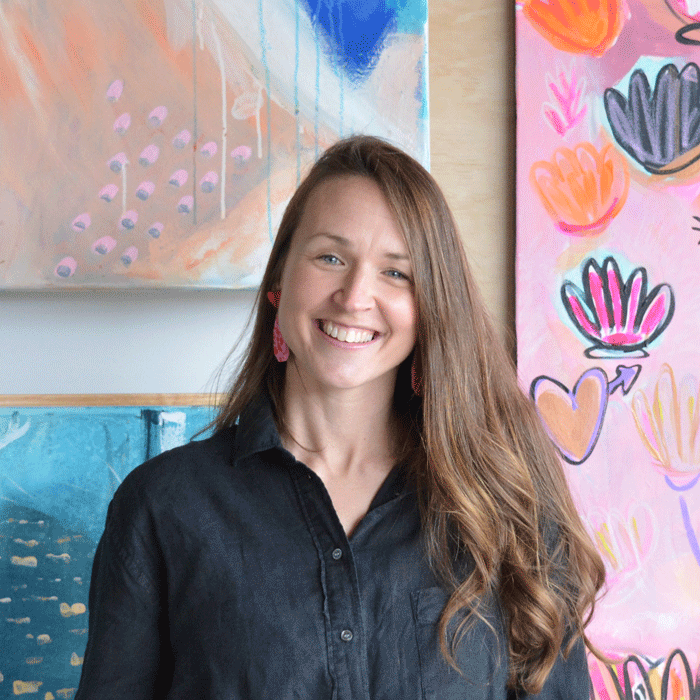
Sarah Molnar
BPsychSc, BBus
Sarah Molnar is an artist, creative facilitator, and mental health educator based on Wadawurrung Country. With a background in psychological science and graphic arts, she is currently studying a Master of Art Therapy at MIECAT and holds a student membership with the Australian, New Zealand and Asian Creative Arts Therapies Association (ANZACATA). Sarah also serves as President of Art of the Minds, a not-for-profit organisation delivering community-based mental health arts initiatives across the Surf Coast.