

Open Access
Published: March 2026
Licence: CC BY-NC-4.0
Issue: Vol.21, No.1
Word count: 2,093
About the reviewer
Cite this reviewHolland, R. (2026). Book review – Art Therapy with People with Learning Disabilities, edited by Nicki Power and Simon Hackett. JoCAT, 21(1). https://www.jocat-online.org/r-25-holland
Book review
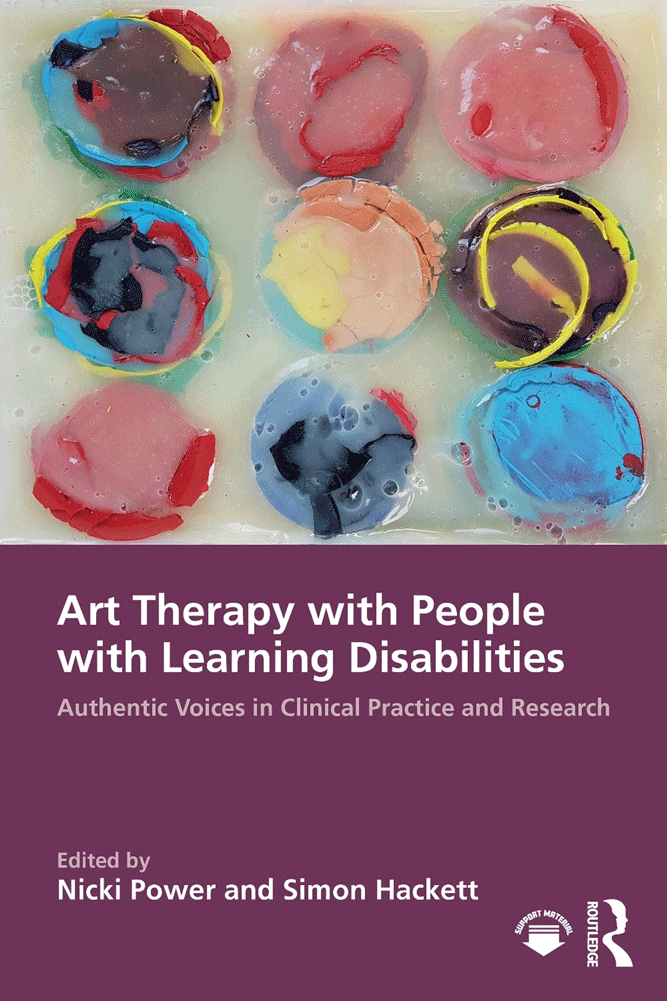
Art Therapy with People with Learning Disabilities: Authentic Voices in Clinical Practice and Research, edited by Nicki Power and Simon Hackett
Publisher: Taylor & Francis Ltd
Published: July 2025
ISBN: 978-1032396507
Reviewed by Rachel Holland
Introduction
Nicki Power and Simon Hackett’s edited volume foregrounds the lived experiences and creative contributions of people with learning disabilities, positioning their voices not as supplementary to professional expertise, but as central to knowledge-making. This orientation aligns closely with relational and co-constructed approaches within art therapy, as well as broader disability-informed paradigms that challenge deficit-based understandings and seek to redistribute epistemic authority. Situated in a post-Covid-19 context, the editors frame the collection as a timely contribution to a developing field of research and practice, addressing ongoing inequities in access to creative and therapeutic spaces for one of the most under-represented communities globally.
The volume brings together a diverse range of chapters spanning individual and group art therapy, community-based and institutional contexts, palliative care, secure settings, gallery-based programs, and participatory initiatives such as Art Hives. Several chapters explicitly engage with justice-oriented concerns, including the intersection of Blackness and disability, sexual trauma, and systemic exclusion within education and care systems. Across the collection, a shared theoretical commitment emerges: the centring of relational knowledge and the valuing of participant voice as a legitimate and generative source of meaning.
Chapters such as Claudia Rossi’s ‘Self-Doubt and the Art of Listening’ (p.70) illuminate the ethical and theoretical importance of listening as a clinical stance, emphasising how people with learning disabilities actively shape therapeutic knowledge through their ways of being, communicating and creating. Similarly, Tania J. Rose’s ‘The Creative Corridor’ (p.135) conceptualises the therapeutic space as one of witnessing and accompaniment, where non-normative forms of communication are held with care, fostering agency, authenticity and aesthetic self-determination. These contributions exemplify the volume’s strength in articulating art therapy as a relational practice that honours difference rather than seeking to normalise it.
At the same time, while the volume consistently values collaboration, the extent to which power is redistributed varies across chapters. This review therefore considers not only the book’s contributions, but also the tensions that arise between professional authority and lived experience, the differing enactments of co-production and the implications of these variations for art therapy practice, research and education.
Theoretical lenses used in this review
As a white female art therapist without a disability, working with both children and adults with learning disabilities, I approach this text, Art Therapy with People with Learning Disabilities, edited by Nicki Power and Simon Hackett, with an awareness of my positionality as an able-bodied, neurotypical practitioner and as a reviewer operating within structures of professional authority. While my clinical work is grounded in collaboration and relational attunement, I remain conscious that I can never fully access or represent the lived/living experiences of people with disabilities. This review is therefore informed by an ethical stance of humility and learning, shaped by the recognition that practitioner knowledge is always partial and situated.
To make this evaluative stance explicit, this review draws primarily on the social model of disability, the neurodiversity paradigm and relational approaches to art therapy to examine how knowledge, agency and authorship are negotiated across the volume. The social model of disability shifts attention away from individual impairment toward the social, structural and institutional barriers that produce exclusion, providing a framework for evaluating how chapters address power, access and systemic inequity (Oliver, 1990; Shakespeare, 2014). The neurodiversity paradigm further reframes cognitive and developmental differences as natural forms of human variation rather than pathology, foregrounding the ethical importance of voice, self-definition and difference within therapeutic and creative practices (Kapp et al., 2013; Singer, 1999).
Relational approaches to art therapy position meaning as emergent through shared, dialogical processes rather than residing solely in expert interpretation (Knill et al., 2005; McNiff, 2009). Moon (2010) further critiques the privileging of professional authority within art therapy discourse, calling for greater reflexivity around power, authorship and interpretation. Drawing on these perspectives, this review attends to how collaboration and power sharing are enacted both within the therapeutic engagements described and in the ways those engagements are authored and represented across the volume.
Co-production and professional authority
Across the volume, approaches to co-production vary significantly, shaping whether lived experience is positioned as central epistemic knowledge or mediated through professional authority. Several chapters demonstrate strong commitments to co-production through shared authorship, participant-led meaning-making and transparent attention to power. Chapters such as Elizabeth Ashby and Joey Mander’s ‘Everyday Trauma’ (p.42), J. Jerwood, G. Allen, V. Peters, S. Reeves, J. Vallance and S. Offley’s ‘Doing Things Differently: Working Together to Talk More about Death and Dying’ (p.55), and Tony Leigh Harrison and Lizzy’s ‘Advocacy and Art Therapy’ (p.109) exemplify this orientation, with people with learning disabilities named as co-authors and positioned as primary knowers of their experiences. In these chapters, participants are actively involved not only in creative processes, but also in shaping decisions related to program design, representation and authorship, with artworks often left uninterpreted by therapists and instead contextualised through participants’ own reflective statements. Such practices foreground relational knowledge and redistribute authority, allowing lived experience to function as generative knowledge rather than illustrative support.
In contrast, other chapters articulate collaborative values while retaining a more traditional distribution of professional authority. In these contributions, lived experience is frequently incorporated through vignettes, therapist-mediated interpretation, or selective quotation, with meaning ultimately framed by professional authorship. For example, Rochele Royster’s ‘Deconstructing Blackness in Disability’ (p.17) offers a justice-oriented and intersectional analysis of Blackness and disability, powerfully naming systemic oppression, yet the theorisation and narrative authority remain located with the practitioner, leaving professional power largely implicit rather than critically examined. Similarly, Rossi’s ‘Self-Doubt and the Art of Listening’ (p.70) and Mizuho Koizumi’s ‘Finding Connection Using Attachment-Based Art Psychotherapy in Secure Care’ (p.124) include participant experiences as illustrative material rather than epistemic contributions. An important nuance emerges in Sandra Hewitt-Parsons’ ‘Revising the Rules of Social Interaction’ (p.186), authored by a disabled art therapist, who reflexively explores the intersection of disabled identity and professional authority, acknowledging how therapeutic roles continue to confer power even when lived experience is shared. This variation does not diminish the value of the volume; rather, it raises important questions about how co-production is enacted in practice, the conditions under which authority is examined or left unspoken, and how institutional, ethical or disciplinary constraints shape whose knowledge ultimately carries weight. These dynamics of authority become particularly visible in relation to how meaning is attributed to participants’ artworks, raising important questions about aesthetic agency within art therapy practice.
Aesthetic agency and meaning-making in arts practice
The issue of aesthetic agency and meaning-making is closely linked to questions of authority and co-production. A key strength of the volume lies in its attention to relational meaning-making, with many chapters allowing artworks to remain open, ambiguous or participant-defined rather than subject to fixed interpretation. Across the collection, artworks are presented as a means of creating visibility for people with learning disabilities and foregrounding creative expression as a legitimate mode of communication, rather than as objects requiring professional decoding. Chapters such as Elizabeth King’s ‘Finding Connection through Group Art Therapy and “Being in a Book”’ (p.80), Toni Leigh Harrison and Lizzy’s ‘Advocacy and Art Therapy’ (p.109) and Shehnoor Ahmed’s ‘Creating a Bridge Between Clinical and Community Space’ (p.149) exemplify this stance by including participants’ own explanations of their artworks alongside images, thereby positioning makers as the primary authorities over meaning. In other instances – including the chapters ‘Everyday Trauma’ (Ashby & Mander, p.42), ‘Doing Things Differently: Working Together to Talk More About Death and Dying: The No Barriers Here Approach’ (Jerwood et al., p.55) and ‘“Art saved my life; it saved my life”: How Art-making Creates Connection and Builds Resilience’ (Gentle & Calhoun, p.93) – artworks are left largely uninterpreted, with emphasis placed on process, relational context and the conditions that enable creative expression.
At the same time, moments of therapist-mediated interpretation introduce productive but unresolved tensions. In ‘Justice: Art Therapy, Power, and Change’ (Benton et al., p.31), for example, the therapist-author describes and interprets a co-author’s artwork in relation to past experiences, explicitly framing aspects of the imagery through a trauma lens. While the chapter as a whole demonstrates strong collaborative intent, this authoritative interpretation risks overriding participant voice and simplifying the complexity of the artwork’s possible meanings. In contrast, ‘Advocacy and Art Therapy: “It helped me piece together what happened”’ (Harrison & Lizzy, p.109) illustrates a more dialogical approach, in which therapist interpretation is later complemented by the co-author’s own explanation, allowing meaning to remain relational rather than fixed. These variations reflect longstanding debates within art therapy regarding interpretation and aesthetic agency, challenging persistent myths that therapists are responsible for assigning meaning to clients’ artworks. Overall, the volume largely aligns with core art therapy values of relational attunement, ethical restraint and client-led meaning-making.
Ethical and trauma-informed dimensions
Several chapters engage thoughtfully with trauma, oppression and systemic harm, though these dimensions are not consistently foregrounded across the collection. Benton et al.’s ‘Justice: Art Therapy, Power, and Change’ (p.31) offers a particularly considered ethical framing, attending to trauma through process rather than disclosure, and emphasising that pacing and readiness differ for each individual. Rather than detailing traumatic content, the authors focus on how safety is held within the therapeutic relationship, including the use of supervision to support the therapist’s embodied responses when witnessing clients’ traumatic experiences. Trauma is also situated within broader systemic contexts, with attention given to the barriers people with disabilities face when seeking justice following experiences such as sexual abuse.
Similarly, Ashby & Mander’s ‘Everyday Trauma’ (p.42) foregrounds the cumulative and insidious nature of trauma arising from marginalisation, discrimination and institutional harm. Through a co-authored account, the chapter acknowledges power in relation to systemic oppression, including diagnostic overshadowing, overmedication and dismissal within medical settings, while emphasising the ethical necessity of tailoring therapeutic approaches to individual needs and priorities. Across these chapters, ethical attentiveness is evident in the ways trauma is named, contextualised and held relationally, even as such explicit ethical framing is less consistently present elsewhere in the volume. These ethical considerations intersect closely with earlier discussions of authorship and co-production, underscoring how trauma-informed practice is shaped not only by clinical stance, but also by who holds interpretive and narrative authority.
Gaps, silences and ongoing tensions
The volume also reveals important absences that have implications for the field’s future direction. Most notably, there is limited cultural and geographic diversity across the chapters, with the majority of contributions reflecting perspectives situated within the Global North. This absence matters not only because people from underrepresented cultures and locations remain unheard, but because it restricts the applicability of the practices described and risks reinforcing dominant norms within art therapy. Given that people living with disabilities already experience marginalisation, the lack of broader cultural representation further entrenches existing power imbalances.
Similarly, while disability is foregrounded throughout the text, there is uneven attention to intersectional identities beyond disability alone. Perspectives relating to LGBTQIA+ identities, culturally and linguistically diverse communities, Indigenous identities, socioeconomic marginalisation, homelessness, addiction and physical disability are largely absent. When people living with disabilities who also experience intersecting forms of marginalisation are not represented, the systemic wound deepens and the scope of the collection narrows. While these absences limit the text’s reach, they also highlight the ongoing evolution of the field, particularly when read alongside earlier works, such as Mair Rees’s Drawing on Difference (2005), which similarly foregrounds shared experiences of disempowerment while advocating for greater service-user involvement. These gaps invite further research, broader collaboration and expanded authorship, while also reflecting systemic publishing and funding constraints within art therapy research.
Conclusion: Contribution and significance
Despite these tensions, the collection offers a meaningful contribution to disability-affirming art therapy practice by centring lived experience and modelling relational, ethically attentive approaches to creative work. The book builds on foundational texts such as Drawing on Difference (Rees, 2005) and Art Therapy and Learning Disabilities: Don’t Guess My Happiness (Bull & O’Farrell, 2012), evidencing how the field has shifted toward more participatory and co-authored practices, while also making visible areas where further growth is needed. Without this volume, the progress made in foregrounding disabled voices within art therapy scholarship would be less apparent and many of the lived experiences shared throughout the text would remain unheard.
The collection will be of particular value to students training to work in disability-affirming art therapy spaces, practitioners seeking reflection, inspiration, or practice development across settings, and educators supporting emerging therapists and researchers. Ultimately, the volume invites readers to move beyond acknowledging privilege toward deepening co-production, expanding authorship and embedding accessibility at the centre of practice and research. In doing so, it contributes to a vision of art therapy that resists othering and honours disabled lived experience as foundational rather than peripheral.
References
Bull, S., & O’Farrell, K. (2012). Art therapy and learning disabilities: Don’t guess my happiness. Routledge.
Kapp, S.K., Gillespie-Lynch, K., Sherman, L.E., & Hutman, T. (2013). Deficit, difference, or both? Autism and neurodiversity. Developmental Psychology, 49(1), 59–71. https://doi.org/10.1037/a0028353
Knill, P.J., Levine, E.G., & Levine, S.K. (2005). Principles and practice of expressive arts therapy: Toward a therapeutic aesthetics. Jessica Kingsley.
McNiff, S. (2009). Integrating the arts in therapy: History, theory, and practice. Charles C. Thomas.
Moon, B.L. (2010). Art-based group therapy: Theory and practice. Charles C. Thomas.
Oliver, M. (1990). The politics of disablement. Macmillan Education.
Rees, M. (2003). Drawing on difference: Art therapy with people who have learning difficulties. Routledge.
Shakespeare, T. (2014). Disability rights and wrongs revisited (2nd ed.). Routledge.
Singer, J. (1999). “Why can’t you be normal for once in your life?” From a “problem with no name” to the emergence of a new category of difference. In M. Corker & S. French (Eds.), Disability discourse (pp.59–67). Open University Press.
About the reviewer

Rachel Holland
MAT, BDesArts, AThR
Rachel (she/her) is an Art Therapist working across education, justice and community settings in Victoria. Her practice spans across a specialist school, substance use recovery programs via the Magistrates' and County Courts (Vic) and private art therapy services supporting children and families impacted by mental health challenges, trauma and domestic violence. Rachel also runs creative workshops from her home studio and within community spaces, where she brings people together through artmaking, reflection and shared stories.