

Open Access
Published: September 2026
Licence: CC BY-NC-4.0
Issue: Vol.21, No.2
Word count: 2,393
About the reviewer
Cite this reviewHalim, A. (2026). Book review – Museum-Based Art Therapy, edited by Mitra Reyhani Ghadim and Lauren Daugherty. JoCAT, 21(2). https://www.jocat-online.org/r-26-halim
Book review
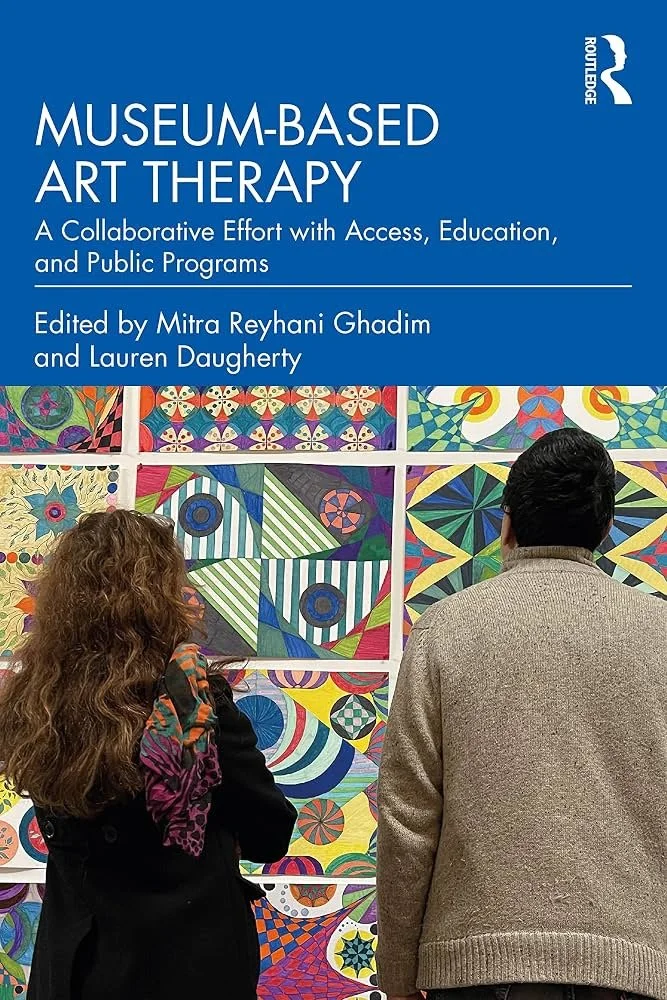
Museum-Based Art Therapy, edited by Mitra Reyhani Ghadim and Lauren Daugherty
Publisher: Routledge
Published: 2022
ISBN: 9780367856533
Reviewed by Alexandria Halim
Introduction
Museum-Based Art Therapy (2021), edited by Mitra Reyhani Ghadim and Lauren Daugherty, gathers a body of work that has, until now, largely gone undocumented: the wellness and art therapy programmes quietly running inside museums across the United States and Canada. Its contributors – art therapists, museum educators, and access professionals – describe partnerships built around juvenile justice, autism, hospitalised children, disability, healthy ageing, and the experiences of People of Colour within cultural institutions. Yet the collection's ambition is not limited to the museum-based programmes documented – but rather presents a broader claim of a larger shift in how therapeutic work is located, shared, and legitimised. Its organising exploration, stated plainly in the preface, is that art therapy “does not operate as a centralized power” but grows “rhizomatically” (p.xv), making connections across a museum's departments and its external partners – an explicit attempt to deconstruct the assumption that therapy belongs only within traditional clinical settings.
Read from the vantage point of inpatient mental health practice, this argument becomes especially charged. Inpatient settings are among the most spatially and institutionally concentrated environments in which art therapy is practised (Versitano & Paton, 2026), making them a useful counterpoint to the museum-based work described in this collection. My experience as an art therapist in inpatient mental health, and now in private practice, has shaped a sustained interest in how therapeutic environments act upon the people within them. From that perspective, Museum-Based Art Therapy reads less as a manual for museum programming than as a proposition about where therapeutic authority is permitted to sit, and how therapeutic practice changes when that authority moves. The term therapeutic authority, as used here, refers to the legitimacy to shape the therapeutic frame: to set its goals, interpret meaning, judge risk, and determine who may take part. The question that organises this review is therefore: what happens to the locus of therapeutic authority when therapy leaves the clinic and enters cultural space?
The book’s central contribution
The book's central contribution is not a technique but a reframing: Reyhani Ghadim and Daugherty (2021) position the museum not as a novel venue for a familiar treatment, but as a therapeutic agent in its own right – the opening chapters make the lineage of that claim explicit. Carolyn Brown Treadon (ch.1) traces the museum's long self-conception as, in Lois Silverman's (2010) phrase, an “institution of social service” (p.24), and revisits the eight therapeutic purposes Silverman (1989, 2010) identified in her foundational reframing of the museum as an agent of social work. Treadon layers onto this Kaplan and colleagues’ (1993) account of restorative environments – the proposition that directed-attention fatigue is relieved by spaces offering properties that they characterise as “being away”, “extent”, “fascination”, and “compatibility”; criteria she argues the museum uniquely satisfies alongside Mangione's (2018) reading of the museum as a co-facilitator of treatment: an evolution rather than an innovation of practice (Treadon, 2021, p.3).
What emerges is a collection less concerned with proving that museum art therapy works than with arguing for its legitimacy: that healing need not be confined to consulting rooms and hospital wards – that cultural institutions can be genuine partners in care rather than backdrops to it. This is the book’s real achievement and yet the seed of its limitations. Its evidence is overwhelmingly descriptive: programme narratives, case examples, and hard-won institutional knowledge that the editors themselves note has gone "generally unpublished" (p.xv), rather than empirical outcome data. The reader is offered a persuasive account of what practitioners are doing, why these programmes have emerged, and how museums are being reimagined as therapeutic partners. Rather than providing definitive evidence of efficacy, the collection establishes a conceptual and practice-based foundation upon which future empirical research can build. For a field that has remained largely undocumented, this is a significant contribution in its own right.
Theme 1 – The museum as a distributed site of therapeutic authority
Across these programmes, the collection suggests that museums distribute therapeutic authority almost by constitution. Unlike a treatment institution, a museum’s obligations are already plural – education, access, public engagement, preservation, and cultural participation – and the art therapy programmes in this collection grow inside that existing plurality rather than alongside it (ch.1, 4). The book’s programme chapters make this concrete. Paige Scheinberg and Kathy Dumlao's discussion of the partnership between the Memphis Brooks Museum and a juvenile justice organisation (ch.3), Reyhani Ghadim’s account of the Queens Museum’s work across access, education, and public programming (ch.4), and Vida Sabbaghi's exploration of COPE NYC internships for autistic students (ch.6) each show therapeutic work co-authored by educators, accessibility staff, and community partners. Authority is shared across educational practice, accessibility work, and community engagement, so that therapeutic change becomes embedded in the museum's wider public mission rather than residing solely within the therapist–client relationship. What distinguishes the museum as a therapeutic setting is that therapeutic work emerges within an institution whose primary commitments already extend beyond treatment. Its civic mission – education, accessibility, preservation, and public engagement – creates partnerships, audiences, and forms of participation that a clinic, organised principally around care, cannot easily reproduce.
Set against inpatient practice, the contrast is stark – though not as absolute as it first appears. Inpatient care tends to concentrate therapeutic authority because it carries responsibilities the museum does not – assessment, risk management, and containment (Bowers, 2014) – and in acute settings the environment is organised first around safety, so that authority gathers around diagnosis and observation (Curtis et al., 2013). Yet this reflects a duty of care rather than a deficiency of therapy: relational and distributed practice happens on wards too, often as art therapy’s deliberate counterweight to that concentration. What the comparison reveals is not that the museum has discovered a better therapy, but how much of what we assume about how therapy should be organised belongs to its institutions rather than to therapy itself.
This is not to cast the museum as authority-free. Even as it distributes the therapeutic frame, it retains – and often tightens – a curatorial and cultural authority of its own: the power to decide what is collected, displayed, and deemed worth preserving. The museum disperses one kind of authority while concentrating another, and it is this second kind that most shapes what happens when a client meets its objects.
Theme 2 – The pre-authored object
While studio art therapy begins with a blank surface, museum-based work begins with objects that arrive pre-loaded. Lauren Daugherty’s chapter on museum collections (ch.13) makes this the crux of the modality: museum artworks are “emotionally charged” (p.178), and the client enters not as maker but as audience to another’s expression. Daugherty enlists Kuspit’s (2010) claim that “the modern artist and her audience are implicitly in a group therapeutic relationship” (p.1), and Csikszentmihalyi’s (1993) argument that we depend on objects psychologically “to help stabilize our minds” (p.178), casting the artwork as something close to a group member within the therapeutic encounter.
What makes this specifically museum-based, rather than simply object-based, matters here: Daugherty is clear that these are not neutral prompts but publicly held, historically situated works: drawing on Silverman (2010), she notes that museum objects allow people to connect “through space and time” (p.179), and on Wadeson (2010) that “great” art “must communicate at a significant level of meaning” (p.4). The client therefore encounters a symbol already invested with collective, aesthetic, and historical weight – canonised by the institution and recognised by the wider culture. This is the resource a museum brings that a studio or a community hall cannot: the object arrives pre-authored not only by an artist, but by the public act of preservation that made it worth displaying.
Read through this review’s lens, this is also where therapeutic authority becomes most interestingly diffuse. If the symbol is authored by an artist, a culture, and a history – and then selected, named, and legitimised by the institution that chooses to display it – then meaning is negotiated rather than generated, and the therapist brokers an encounter with a symbol that already exists rather than midwifing one into being. From this perspective, the museum’s curatorial decisions – what is collected, shown, and deemed worth preserving – enter the therapeutic encounter as a kind of third party, and the meanings most available to the client are partly those the institution has already sanctioned.
Yet pre-authored is not predetermined. The object arrives dense with inherited meaning, but what the therapeutic encounter makes of it stays open: the client negotiates with that meaning – accepting, resisting, or reinterpreting it while considering their own experience – rather than simply receiving it. The museum sets the terms of the meeting; it does not settle what passes within it. Indeed, the object’s independence is part of what makes it useful: unlike a blank surface, it can offer the client something they did not bring: a resonance, a counter-position, a surprise – so that the work happens in the meeting of the client’s projection and the object’s own charge.
Theme 3 – From visitor to contributor
Perhaps the book’s most compelling contribution is not about where therapy takes place, but who it allows participants to become once participants are trusted with genuine responsibility. Its most striking illustration is Vida Sabbaghi's account of the internship COPE NYC ran with the Queens Museum’s ArtAccess programme (ch.6). After forty hours of preparation, a cohort of young adults – among them neurodivergent high-school students, a student with a fluctuating mood disorder, and young adults from a day rehabilitation centre – were trained not as visitors but as museum interns: they learned the institution’s mission and the history of its Panorama of the City of New York, and on 12 April 2018 led the Panorama tour themselves, for the first time since the exhibit’s creation in 1964. Dressed professionally and working in teams by borough, some recited memorised facts while others guided their audience with the open prompt “What do you see?”. They were not receiving a service; they were entrusted to represent the museum to the public.
The same repositioning runs, more quietly, through the studio chapters. Stephen Legari’s Art Hive at the Montréal Museum of Fine Arts (ch.10) is a drop-in community studio where 15–50 people make work side by side across differences of age, language, and ability; its explicit aim, in Legari’s words, is to empower the public “not only as recipients of culture, but as actors in its shaping” (p.148). Rachel Shipps’ MakeArt Lab at the San Francisco Museum of Craft and Design (ch.9) likewise builds a hands-on room adjacent to the galleries to cultivate what she calls “the feeling of agency” (p.133) – through choice in self-directed making and the incidental social connection of working alongside others. Across all three, the participant shifts from recipient to contributor: intern, maker, collaborator, member of a community that treats itself, in Legari's framing, as the client.
The therapeutic significance of these programmes lies not simply in participation but in entrustment: the difference between being involved in an activity and being granted genuine agency within it . To hand interns a tour is to lend them a share of the museum's own authority to interpret and represent itself – not merely to take part in culture, but to speak for the institution to its public (ch.6). This maps closely onto recovery-oriented practice and its insistence on agency, contribution, and self-definition (Leamy et al., 2011); but the museum gives it a civic dimension a clinic cannot, because the role on offer is a public one. It is precisely the position an inpatient ward is least able to extend, and it is where the museum model has most to teach settings that cannot themselves become galleries: that being entrusted with a real role may itself be therapeutic.
Critical reflection and future directions
As the editors themselves acknowledge, the field is still documented largely through programme narratives and practice accounts, and the collection succeeds as a conceptual and practice-building text rather than an evaluative one. In an emerging field this is not a lesser form of knowledge but its necessary first stratum: it makes tacit clinical craft visible, records what practitioners have found to work in situ, and generates the hypotheses that evaluation can later test. The central argument developed in this review – that museums redistribute therapeutic authority – is one the book supports but does not set out to test. That is less a failure than a stage: the framework is now clear enough to invite participant-reported outcomes, qualitative accounts of the museum encounter, and longitudinal follow-up capable of asking whether, and for whom, this redistribution changes outcomes.
The collection convincingly demonstrates what museums make possible, but leaves open a question that its own success invites: what, precisely, is doing the therapeutic work? Across these chapters, therapeutic change is associated with cultural objects, public purpose, distributed authority, participation, and institutional trust. Yet these elements remain tightly interwoven, making it difficult to distinguish which are distinctive to the museum itself and which might arise wherever therapeutic practice is embedded within a civic institution. The question is not whether museums can be therapeutic – the collection makes a compelling case that they can – but which factors, exactly, the museum contributes to that therapeutic possibility. Establishing which features of the museum environment actually carry therapeutic weight is perhaps the most valuable line of enquiry the collection opens.
This is where the collection becomes most productive: in showing that therapeutic practice changes with its institutional setting, it turns a book about a specialised mode of practice into a way of thinking about therapeutic environments more broadly.
Conclusion
Museum-Based Art Therapy reads less as a collection of museum programmes than as a proposition about where therapeutic authority is permitted to sit, and how therapeutic practice changes when that authority moves. Its case studies will be of practical use to art therapists, museum educators, and access and public-programming staff; its larger provocation belongs to anyone – clinician, community practitioner, or researcher – interested in how the place of therapy shapes what therapy can be. The evidence base is still emerging, but the conceptual questions the collection raises are likely to shape the next stage of museum-based art therapy research. Read this way, the book makes plain what the consulting room keeps hidden: that the institutions that hold therapy are never neutral, and neither are the forms of care they make possible.
References
Bowers, L. (2014). Safewards: A new model of conflict and containment on psychiatric wards. Journal of Psychiatric and Mental Health Nursing, 21(6), 499–508. https://doi.org/10.1111/jpm.12129
Curtis, S., Gesler, W., Wood, V., Spencer, I., Mason, J., Close, H., & Reilly, J. (2013). Compassionate containment? Balancing technical safety and therapy in the design of psychiatric wards. Social Science & Medicine, 97, 201–209. https://doi.org/10.1016/j.socscimed.2013.06.015
Kaplan, S., Bardwell, L.V., & Slakter, D.B. (1993). The museum as a restorative environment.
Environment and Behavior, 25(6), 725–742. https://doi.org/10.1177/0013916593256004
Leamy, M., Bird, V., Le Boutillier, C., Williams, J., & Slade, M. (2011). Conceptual framework for personal recovery in mental health: Systematic review and narrative synthesis. British Journal of Psychiatry, 199(6), 445–452. https://doi.org/10.1192/bjp.bp.110.083733
Mangione, G. (2018). The art and nature of health: A study of therapeutic practice in museums. Sociology of Health & Illness, 40(2), 283–296. https://doi.org/10.1111/1467-9566.12618
Reyhani Ghadim, M., & Daugherty, L. (Eds.). (2021). Museum-based art therapy: A collaborative effort with access, education, and public programs. Routledge. https://doi.org/10.4324/9781003014386
Silverman, L.H. (1989). “Johnny showed us the butterflies”: The museum as a family therapy tool. Marriage & Family Review, 13(3–4), 131–150. https://doi.org/10.1300/J002v13n03_08
Silverman, L.H. (2010). The social work of museums. Routledge. https://doi.org/10.4324/9780203862964
Versitano, S., & Paton, J. (2026). Inpatient adolescent mental health care: Art therapy, acute distress, and restrictive practices. International Journal of Art Therapy. Advance online publication. https://doi.org/10.1080/17454832.2026.2614094
Wadeson, H. (2010). Art psychotherapy (2nd ed.). John Wiley & Sons.
Reviewer

Alexandria Halim
MAT, AThR, ACA Reg
Alexandria is an art therapist based in Sydney, Australia, working across private and public adult inpatient mental health. Her clinical and research interests centre on therapeutic environments, institutional care, and recovery-oriented practice. Her current work develops arts-based approaches to evaluate the relationship between therapeutic practice, institutional design, and creative engagement in mental health settings. Alexandria is a registered member of the Australian, New Zealand and Asian Creative Arts Therapies Association (ANZACATA) and the Australian Counselling Association (ACA).
Email: alexahalim@outlook.com