

Open Access
Published: July 2026
Licence: CC BY-NC-4.0
Issue: Vol.21, No.1
Word count: 2,920
About the reviewer
Cite this reviewDunne, S. (2026). Exhibition review – Are you lonely tonight? I’m so lonesome I could cry at the Australian Centre for Contemporary Art (ACCA). JoCAT, 21(1). https://www.jocat-online.org/r-26-dunne
Exhibition review
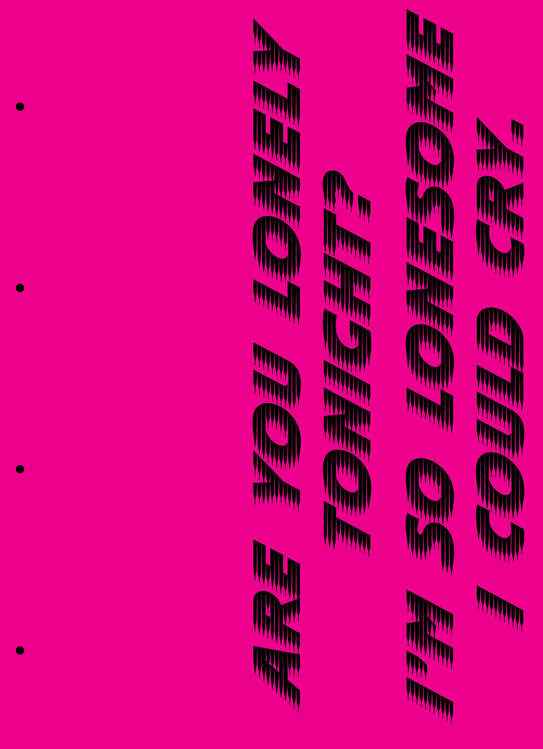
Are you lonely tonight? I’m so lonesome I could cry at the Australian Centre for Contemporary Art (ACCA)
Artists: Gideon Appah, Polly Borland, Seth Brown, Lucy Liu, Natasha Matila-Smith, Kayla Mattes, Callum McGrath, Nick Mullaly, Melissa Nguyen, Patrick Pound, Kelly Yu
Curated by Sophie Prince and Myles Russell-Cook
3 July – 30 August 2026
Reviewed by Sandy Dunne
Introduction
The exhibition, based on the theme of loneliness, is the first in the Art and Emotion series running at the Australian Centre for Contemporary Art (ACCA) over the next three years. Upcoming are rage (2027) and joy (2029). Are you lonely tonight? I’m so lonesome I could cry (2026) offers diverse expressions of loneliness from eleven Australian and international artists, and is imaginatively curated by Sophie Prince and Miles Russell-Cook. The title, which combines a lament popularised by Elvis Presley and another containing Hank Williams’ haunting lyrics, signals the emotional tenor of the exhibition. As described in the catalogue, it offers moments of vulnerability, isolation and longing (ACCA, 2026). Indeed, feelings of yearning and sentimental melancholy permeate the exhibition space, in which we are invited to explore the concept of loneliness by “being alone together”. From the outset, I am apprehensive that this curatorial approach to loneliness, while comforting, may not quite plumb the emotional depths I am expecting. A recurring theme is the continual interplay between the cognitive and the affective that occurs during both the creation of, and the response to, an artwork, a tension that underpins my journey through Are you lonely tonight? I’m so lonesome I could cry.
In this review I aim to filter my personal experience of the exhibition through an art therapy lens. First, I present ACCA as a site of emotional containment, a key concept of psychodynamic theory and object relations. I then draw on the Expressive Therapies Continuum (ETC) and neuroscience to examine the artists’ use of materials and processes to regulate emotions and activate different levels of creative engagement. This leads into a feminist/critical theory perspective of loneliness as a shame narrative that frequently masks its societal and structural causes and can create dissonance between private and public personas. The review then incorporates narrative and eco-art therapy lenses to draw attention to artworks that offer nourishment and relief from loneliness by reframing dominant stories. Finally, I reflect on my own growing sense of disconnection and try to reconcile this with the curatorial aims of Are you lonely tonight? I’m so lonesome I could cry.
Psychological and physical containment
In a broad way, the cavernous interior of ACCA can be considered as a massive vessel for the containment of difficult emotions. And on a smaller scale, individual artworks have physical borders that serve as containers for hard-to-manage feelings. The concept of a psychological holding space is evident in curatorial decisions, such as the lone goldfish swimming in a small tank at the exhibition entrance, a symbol of containment as well as the structural dimension of loneliness. We are invited to view Kelly Yu’s video Endling from a comfortable old couch, flanked by two side-tables holding ‘loneliness’ books and a reading lamp. This ‘living room’ effect protects us from the vastness of the gallery while also decreasing our physical distance from others on the couch – which could be comforting, or just the opposite.
Figure 1. Co-curator Myles Russell-Cook’s own goldfish and tank, ACCA, Naarm Melbourne, 2026. All photographs taken by Sandy Dunne, with permission.
Figure 2. Part of the viewing installation for Kelly Yu, Endling, 2024, video.
Natasha Matila-Smith’s installation If I die, please delete my Soundcloud is positioned so that we face a wall while sitting or lying on the bed, watching the screen. Through headphones, an abstract electronic soundscape increases the sense of being cut off from the rest of the room, and the world.
Figure 3. Natasha Matila-Smith, If I die, please delete my Soundcloud, 2019, single-channel digital video with sound. Installation view with bed, sheets, pillows, headphones, laptop computer.
This auditory isolation is echoed in Callum McGrath’s two-channel video installation What’s after this? Presented in a darkened room, the supporting scaffold and smoke machine add to a sense of presence, sharing the empty spaces or the heightened energy of the dance floor. The constant beat of the music could be emotionally dysregulating, but otherwise, it is a psychologically safe space, where I can feel alone with the artwork, invisible and impervious to judgement.
Figure 4. Callum McGrath, What’s after this? 2019, two-channel video with sound, haze, box truss. Installation view.
The Expressive Therapies Continuum
Moving through the exhibition with reference to the ETC and the fluid–resistive scale of materials (Hinz, 2020), there is an emphasis on the cognitive-symbolic level and generally more resistive materials, both of which provide a defence against emotional flooding. A notable exception is Polly Borland’s larger-than-life-size sculpture BOD, which has a powerful somatic presence that indicates activation of the sensory – kinaesthetic and perceptual – affective levels of the ETC. Borland described BOD as “a physical manifestation of thoughts which press in on us when we are alone… pulling us down”. Similarly, although the distortions of her smaller sculptures may communicate playfulness, the ‘wounds’ of Slit and Froggy evoke a visceral response. At the artists’ walk-through, Borland spoke about the discomfort experienced by her models; while she builds her sculpture around them, they are restricted physically and sensorily deprived. In contrast, there is a protective aspect of her figures’ padded protuberances; the human inside is cocooned, cushioned from threat, just as we isolate and protect ourselves with clothing and other defences. “Loneliness is the fear of other people and what other people are capable of” (Borland, personal communication, 4 July 2026).
Figure 5. Polly Borland, BOD, 2023, aluminium. Installation view.
Figure 6. Polly Borland, Slit, 2025, painted cast aluminium, left, and Toothy, 2025, pigmented cast resin, right. Installation view.
Object relations and attachment theory
Patrick Pound’s Museum of Loneliness is a sprawling collection of more than 170 objects that have (or could have) some connection with loneliness. In object relations and attachment theory (Winnicott, 1971), this reliquary of flotsam and jetsam from other people’s lives may function as transitional objects, anchors against loss of relationship. By collecting, sorting and categorising things, the artist exercises control; in contrast, human relationships can be unpredictable and painful. Pound explains that his approach resembles a dare (P. Pound, personal communication, 4 July 2026). Viewers are invited to share in this potential space of play and art by entering into a meaning-making dialogue with any objects that resonate. For example, Polly Borland drew a personal link to The Lonely Doll, a book which she remembers from childhood.
Figure 7. Patrick Pound, The museum of loneliness, 2026, found objects, photographs and ephemera, site-specific installation. Back wall: Melissa Nguyen, A letter to my mother, a letter to your mother.
Nervous-system regulation
Viewed through a neuroscience lens (King et al., 2019),the calming and emotionally regulating function of repetitive actions is evident in the tiny knots of Kayla Mattes’ process. She took over a year to stitch Lonely Planet, a large, intricate tapestry that archivesa complex anthology of digital memes, emojis and text along with some images from the physical world. It was created against the background of a worsening political situation in the USA, so as a story-cloth it contains despair, anger and disillusionment. Garlock (2021) observed that “When people are repressed or subjugated, stitching can become more than therapeutic. It can become an act of defiance” (p.200). The contrasting juxtaposition of a traditional art form and contemporary subject is reflected materially in Mattes’ transformation of hard, standardised, electronic screen images into soft, heterogenous, hand-dyed (to imitate pixilation) wool. This texture promises warmth and comfort, a soothing antidote for doom-scrolling loneliness. Like Pound’s Museum of loneliness, Matte’s creation is impressive in its breadth and detail, but neither work resonates with me on an emotional level.
Figure 8. Kayla Mattes, Lonely Planet, 2025–26, hand-woven cotton, hand-dyed wool, mohair, faux fur, silk, acrylic, polyester, beads. Installation view.
Figure 9. Kayla Mattes, Lonely Planet (detail).
Seth Brown’s Frank is a simulacrum of a hotdog sausage attached to a mustard bottle, endlessly scrolling for the non-existent, perfect AI bun. A symbol of futile persistence, this artwork conceptualises loneliness as the search for our missing complement, for whatever (or whoever) it is that will make us feel whole. A profound message is presented with optimistic humour, which can protect against depression, according to Tucker et al. (2013). In contrast, the self-deprecating humour of Matila-Smith’s If I die, please delete my Soundcloud is a style they found to be a risk factor for depression, suicide ideation and suicide. The young woman in the bed is full of self-doubt; she has withdrawn from active participation in the physical world but yearns for connection, “I just wanna be spooned”, and affection, “I wish someone would buy me flowers”. She turns to social media for solace and affirmation, which is likely to increase her feelings of loneliness (O’Day & Heimberg, 2021). Her retreat to the safety of bed is described as the Gen Z practice of ‘bed-rotting’. The young woman’s feelings of pain and diminished self-worth are palpable, and despite the cognitively laden text and installation design, there is a significant affective component to the artwork that connects it with Borland’s embodied sculptures in the same room. It also provides a direct link to our understanding of the structural causes of loneliness.
Figure 10. Seth Brown, Frank, 2024, Footy Frank hot dog, mobile device, AI-generated imagery, mustard bottle, hobby motor. Installation view.
Figure 11. Natasha Matila-Smith, If I die, please delete my Soundcloud, 2019, single-channel video with sound. Installation view (detail).
Shame vs structure
Loneliness has historically been presented as a personal failing, a feature of a deficient personality, and hence a source of shame. Shame creates a barrier which prevents sharing and connection with others who could provide validation and support. Cooper (2024) advocates reauthoring the ‘shameful personal defect’ of loneliness as a response to systemic pressures and injustices. Wilkinson (2022) agrees that loneliness is a political issue and argues that the popular slogan ‘Loneliness doesn’t discriminate’ effectively obscures the heteronormative dominance, economic and racial inequalities, domestic violence, housing insecurity and social abandonment that exhaust people and disconnect them from their communities. Using a feminist lens, Barbosa (2026) advocated for ‘bed-rotting’ as an intentional withdrawal of female labour from an exploitative patriarchal system, and it is interesting to potentially reframe the experience of Matila-Smith’s ‘sad girl’ in this light.
Private vs public
Lucy Liu and Melissa Nguyen investigate feelings of aloneness and loneliness through cultural connections, family and migration. In three large acrylic paintings, En cachette (2008), Je suis, Envois-moi (2008) and Moi et Les Autres (2008), Liu plays with the Japanese tradition of shunga, stylised erotica created for mass-production by the painstaking process of woodblock printing. Liu’s fluid brushstrokes indicate an affective engagement with the material, in contrast with the highly controlled process of conventional shunga. Alone and with others, her larger than life, partially clothed figures are given permission to cavort sensually on the canvas where they are the focus of meaning-making by the viewer and possibly the artist herself. What is private and what is public? Could Liu be using the canvas as transitional object to explore her identity, whilst remaining emotionally intact?
Figure 12. Lucy Liu, En Cachette, Je suis. Envois-moi and Moi et Les Autres, 2008, acrylic on canvas, from the Shunga series. Installation view.
An conceal–reveal is also contained in Melissa Nguyen’s A letter to my mother; A letter to your mother, three large diptychs painted with rabbit-skin glue on canvas, almost monochrome, so that the subject is only visible when the light hits at particular angles. Nguyen maintains a high degree of control over the medium, functioning in the cognitive-symbolic level of the ETC to explore highly personal and emotive subject matter. Her work is a public record of her effort to get closer to her mother, who arrived in Australia as a refugee from Vietnam and has only one photo of her early life. Applying a trauma-informed lens, it is quite probable that both mother and daughter are on a journey where displacement trauma is being processed through art-making at a safe rate, and that future works may be less visually ambiguous. When asked why she made her paintings so difficult to ‘read’, Nguyen replied, “Because it’s about my family, not yours”, drawing an important distinction between her inner and outer worlds, what is for private and what is for public consumption (M. Nguyen, personal communication, 4 July 2026).
Figure 13. Melissa Nguyen, A letter to my mother; A letter to your mother, 2026, rabbit-skin glue on canvas. Installation view.
Eco-art therapy and reintegrating with nature
Kayla Mattes’s integration of rapid digital technology and slow artmaking by hand in Lonely Planet may represent a flight from loneliness towards a connection with nature. Loneliness, powerlessness, hopelessness and depression are all feelings associated with climate change and species extinction (Wharldell, 2024). Conversely, time spent in and with nature has been shown to decrease psychological distress and depression (Hyvönen, 2023). Gideon Appah’s dual screen video installation Beyond the shadows: Gideon Appah Poetic Vision features calming coastal scenery of West Africa, the physical beauty and strength of able-bodied youth surfing, and a gentle, meditative voice reassuring the audience to trust our inherent power, to fully inhabit our bodies and to just be, rather than do. The theme of nature as companion is repeated in Appah’s painting, Boy with a bird (2023), and I wonder about cultural influences in the idea of loneliness and connections with nature.
Figure 14. Gideon Appah, Beyond the shadows: Gideon Appah Poetic Vision, 2025, two-channel video with sound. Installation view.
Figure 15. Gideon Appah, Boy with a bird, 2023, acrylic and oil on canvas. Installation view.
Existential loneliness caused by ecological destruction is reflected in Kelly Yu’s video Endling, a satirical ‘documentary’ about Pau Pau, the last goldfish on Earth, and his devoted caretaker, Richard. Although a solitary figure, Richard appears to be content; his life has purpose. Richard’s attempts to entertain Pau Pau are bizarre and hilarious. However, when he dies, Pau Pau is truly alone, his one secure attachment severed, his future at the mercy of a ruthless corporate world. Yu’s work provides an external vehicle onto which we can project feelings of loneliness, and the fear of being truly and irrevocably alone amidst total structural collapse.
Figure 16. Kelly Yu, Endlings, 2024, short film. Partial installation view showing detail of video screen.
Changing the narrative
Using a narrative therapy lens (White & Epston, 1990) – externalisation of the problem of loneliness and creating new narratives to replace the old ones that no longer (or never did) serve us – is a focus for Nick Mullaly and Callum McGrath. Mullaly’s luminous paintings capture moments in time from his life post-Covid and post-breakup, when he decided to go out clubbing again. Full of light and warmth, some movement, some stillness, a sense of community and camaraderie is evident. Mullaly spoke of his love of dance music and the function of Melbourne’s queer club scene as almost religious gathering spaces after lockdown (Mullaly, personal communication, 4 July 2026). The fluidity of oil paint indicates an affective component in Mullaly’s work, emotions that are contained within the borders of the six small and three larger canvases.
Figure 17. Nick Mullaly, (clockwise from left) Toss, Second wind, Payment, Peering, Key apparition, Microphone, 2026, oil on canvas. Installation view.
In the adjoining room, there is no sequential logic to Callum McGrath’s What’s after this?, which echoes a common presentation of trauma memories (Van der Kolk, 2015). The experience is highly sensory. There may be a feeling of loneliness when surrounded by other people. McGrath rewrites his own story, as well as reclaiming and centring the stories of queer dance culture, “the stories that no one else was going to write” (McGrath, personal communication, 4 July 2026). This is vividly illustrated in crowd scenes, with people turning their phones to selfie mode, thus inserting themselves into history. McGrath’s work is also a homage to iconic venues and artworks, as he actively archives what may otherwise be lost. Healing trauma, integrating different aspects of identity, and reframing shame narratives are all central to the work of these two artists.
Figure 18. Callum McGrath, What’s after this?, 2026, two-channel video with sound, haze, box truss. Installation view.
Conclusion
On leaving the gallery, I feel strangely unmoved and personally under-represented. My own experience of what loneliness can mean is most fully validated by Borland’s embodied response, the despair of Matila-Smith’s ‘sad girl’ and the loss and fear of loss expressed in Yu’s video. I am unable to read a felt sense of the life-sapping void of loneliness in most of the other artworks, which either emanate poignant yearning and sorrow, or present an escape from loneliness altogether. I definitely want more: the loneliness of ageing, of being in an unloving relationship, of illness and disability, of being homeless, a stranger, an inmate, and all the loneliness caused by difference and exclusion and stigma, and which, as the curators acknowledge in the scholarly exhibition catalogue (which contains some excellent essays) they are unable to include. Ultimately, by privileging a ‘top-down’ approach and focusing on emotional containment, they have created a psychologically safe environment where visitors can explore loneliness on an intellectual level without necessarily feeling it. And to be fair, there are more than enough challenges for us all outside the gallery walls.

Click to view this exhibition on the Australian Centre for Contemporary Art website.
References
Australian Centre for Contemporary Art. (2026). Are you lonely tonight? I’m so lonesome I could cry. https://acca.melbourne/exhibition/are-you-lonely-tonight-im-so-lonesome-i-could-cry/
Barbosa, A.C. (2026). Toxic assets: Bed rotting as an embargo on the female anger supply chain. European Journal of Women’s Studies. https://doi.org/10.1177/13505068261457004
Cooper, F. (2024). ‘Solitude is not thrust upon any lovable person’: Loneliness, shame and the problem (of) personality. Journal of Psychosocial Studies, 17(1), 28–45. https://doi.org/10.1332/14786737Y2023D000000004
Garlock, L.R. (2021). Alone in the desert: Making sense of the senseless through story cloths. In L. Leone (Ed.), Craft in art therapy: Diverse approaches to the transformative power of craft materials and methods (pp.190–203). Routledge.
Hinz, L.D. (2020). Expressive Therapies Continuum: A framework for using art in therapy (2nd ed.). Routledge.
Hyvönen, K., Salonen, K., Paakkolanvaara, J., Väkeväinen, P., & Korpela, K. (2023). Effects of nature-based intervention in the treatment of depression: A multi-center, randomized controlled trial. Journal of Environmental Psychology, 85, 101950. https://doi.org/10.1016/j.jenvp.2022.101950
King, J.L., Kaimal, G., Konopka, L., Belkofer, C., & Strang, C.E. (2019). Practical applications of neuroscience-informed art therapy. Art Therapy, 36(3), 149–156. https://doi.org/10.1080/07421656.2019.1649549
O’Day, E.B., & Heimberg, R.G. (2021). Social media use, social anxiety, and loneliness: A systematic review. Computers in Human Behavior Reports, 3, 100070. https://doi.org/10.1016/j.chbr.2021.100070
Prince, S. (2026) Alone together. In S. Prince & M. Russell-Cook (Eds.), Are you lonely tonight? I’m so lonesome I could cry. The 2026 exhibition catalogue, (pp.59–69). Australian Centre for Contemporary Art. https://acca.melbourne/exhibition/are-you-lonely-tonight-im-so-lonesome-i-could-cry/
Tucker, R.P., Wingate, L.R., O’Keefe, V.M., Slish, M.L., Judah, M.R., & Rhoades-Kerswill, S. (2013). The moderating effect of humor style on the relationship between interpersonal predictors of suicide and suicidal ideation. Personality and Individual Differences, 54(5), 610–615. https://doi.org/10.1016/j.paid.2012.11.023
Van der Kolk, B.A. (2015). The body keeps the score: Brain, mind, and body in the healing of trauma. Penguin.
Wharldall, B. (2024). Toward multispecies mourning: Imagining an art therapy for ecological grief. Art Therapy, 41(3), 128–134. https://doi.org/10.1080/07421656.2024.2363086
White, M., & Epston, D. (1990) Narrative means to therapeutic ends. Dulwich Centre.
Wilkinson, E. (2022). Loneliness is a feminist issue. Feminist Theory, 23(1), 23–38. https://doi.org/10.1177/14647001211062739
Winnicott, D.W. (1971). Playing and reality. Tavistock.
Reviewer
Sandy Dunne
MAT, MEd, Dip Ap Sc, AThR
Sandy Dunne is an art therapist, educator and artist living on the unceded lands of the Kulin Nations (Naarm, Melbourne). With a background in secondary schools and community-based arts practice, her art therapy experience includes working with carers and survivors of family violence as well as children, youth and women’s mental health. Her approach uses feminist and social justice frameworks. Currently Sandy is painting the inside of cupboards at her private practice, Art Therapy House and Garden. She is in the process of creating a welcoming multi-practitioner space where the benefits of art therapy are combined with the restorative power of nature.