

Open Access
Published: June 2026
Licence: CC BY-NC-4.0
Issue: Vol.21, No.1
Word count: 1,994
About the reviewer
Cite this review Ahluwalia, J.K. (2026). Space, place and dramatherapy: International perspectives, edited by Eliza Sweeney. JoCAT, 21(1). https://www.jocat-online.org/r-26-ahluwalia
Book review
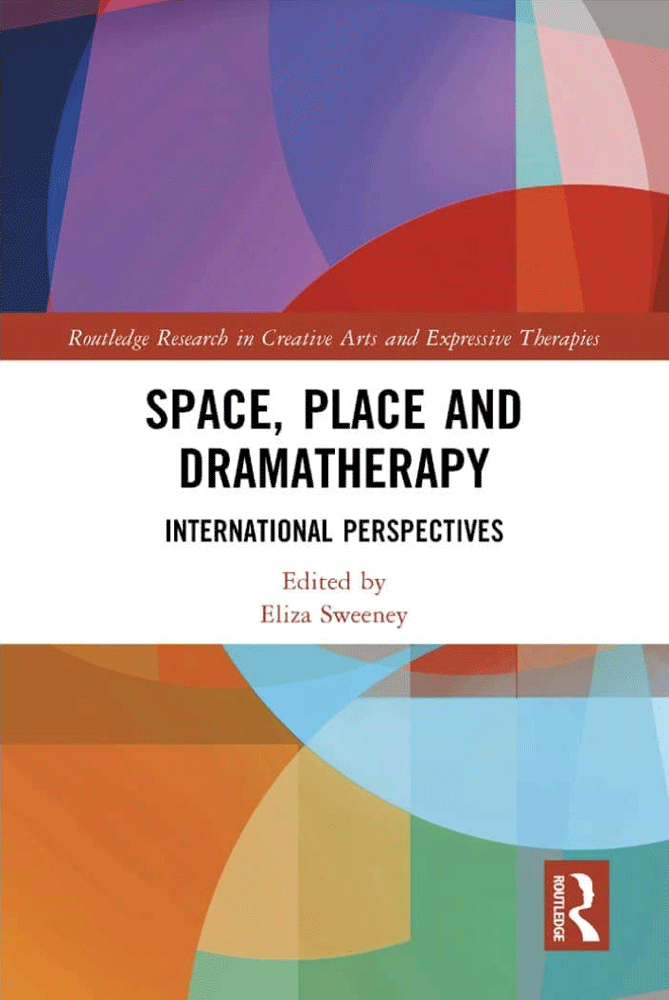
Space, Place and Dramatherapy: International Perspectives, edited by Eliza Sweeney
Publisher: Routledge
Published: May 2025
ISBN: 9781032172347
Reviewed by Jasmine Kaur Ahluwalia
Introduction
Space, Place and Dramatherapy: International Perspectives, edited by Eliza Sweeney, takes up a question that has long sat at the edges of clinical discourse: what does the room itself do? Sweeney brings together ten contributors from across Europe and beyond to position space and place not as backdrop to the therapeutic encounter but as active participants within it. The collection is timely. Its genesis runs parallel to the Covid-19 pandemic, a period in which the physical parameters of practice were upended almost overnight, and practitioners found themselves navigating the distance between what they knew of embodied, co-present work and what a screen could hold.
I read this volume as a dance movement therapist, and that lens shapes what I notice. In DMT, space is not incidental: the kinesphere, the felt sense of near and far reach, and the body’s directional navigation of a room are material realities that shape how a person inhabits their world (Moore, 2014; Meekums, 2010). Sweeney frames space in the prelude as having a “multiple, differential, personal, experiential and playful” quality (2024a, p.2), and reading this collection through a DMT lens surfaces resonances that cut across modalities: space as something felt before it is named, negotiated before it is understood. Bird’s (2024) chapter recovers the concept of the stage as sacred and ritually prepared space, while Musicka-Williams’s (2024) delineation of four spatial dimensions, psychological, physical, imaginative, and intersubjective, are among the moments where this argument is most clearly made. The collection is ambitious, and at its best, genuinely useful.
Summary
The book is organised into three parts: The Built Environment and Scenography in Dramatherapy, Education and Play Space in Dramatherapy, and Ritual, Intersubjective and Spiritual Space. Rather than moving chapter by chapter, what follows traces four spatial dimensions recurring across the collection.
Physical space
Several contributors engage with the material conditions of the therapy room. Sweeney’s grounding question, “what are these spaces doing and how can we understand what they are doing so that we can offer best practice?” (2024a, p.8), runs as a through-line. Richardson (2024) offers a vivid response: children building huts within the therapy space, “enjoying freedom from the rules of the adult world” (p.36), where claiming and shaping a corner of the room became the therapeutic work itself. Sweeney’s (2024b) chapter extends this through the figure of the curtain, an object that divided real from imaginal and gradually became a transitional object in the Winnicottian sense (Winnicott, 2005). Stergiou (2024), working in a prison setting, shows that when the physical space cannot be modified, working creatively within its constraints becomes a clinical statement about the body’s right to define its own boundaries.
Intersubjective space
Running through almost every chapter is the idea that therapeutic space is made not by the room alone but by what passes between the people within it. Sweeney (2024b) introduces spacing as a verb: an ongoing negotiation that is simultaneously relational and spatial. Mann Shaw (2024) develops this through the play-space as a relational container, where the therapist shifts from witness to co-player to co-creator, enabling what she calls the “displacement of meaning” (p.99), a form of aesthetic distance through which overwhelming emotions can be examined. This resonates with intersubjective theory’s understanding of the therapeutic relationship as a mutually regulated, co-constructed encounter (Stern, 2010; Tronick, 2018).
Imaginative space
This collection reframes imagination as a space in its own right. Bruun (2024) establishes this through the concept of poetic space, where vocal work and inner listening allow participants to move inward while “encompassing our subjective bodies” and “connecting us across time and space” (p.26). Stergiou (2024) extends this into the body itself through neutral mask and embodied dreamwork, where participants are guided into imaginal territory via somatic awareness, using the mask as a threshold between habitual self and deeper, less-conditioned experience. The as-if space familiar in dramatherapy discourse is given a spatial meaning here: a place one inhabits and leaves, the passage shaped by the body as much as by dramatic form.
Bayley (2024) adds a cross-cultural register, drawing on Hindu-Buddhist spatial philosophy to suggest that imaginative space carries resonances beyond Western therapeutic frameworks, a thread explored further in the analysis below.
Ritualistic space
Several contributors converge on the idea that the therapeutic space requires ritual: deliberate, repeatable acts that mark a threshold. Bird (2024) describes the therapy room as “a container for the client’s psyche” (p.164) and writes of a “cleansing ritual” (p.164) that allows a client to shed conditioned reality before entering. Musicka-Williams (2024) speaks of embodied bridge-ins and closing rituals that build predictability for neurodivergent children, noting that co-creating these rituals deepens client ownership of the space. Jaaniste (2024) returns to the theatrical notion of the empty stage as a space charged only through witnessed action. What these contributions share is an understanding that the therapy room is not simply entered: it is crossed into, and that crossing requires form.
Analysis
Space as decolonial praxis
One of the book’s more quietly political threads concerns space, power, and the therapeutic frame. Sweeney (2024b) raises the possibility that co-designing the therapy space with clients is itself a decolonising act. The therapist, by virtue of professional role and institutional context, already occupies a position of power in the room. Co-creation, as Sweeney frames it, is a way of sharing that power: an invitation for the client to have a hand in shaping the conditions under which the work unfolds, so that the space itself becomes safe enough to enter fully. As Sweeney puts it, “we shape ourselves by shaping the world” (p.58). This connects directly to Sajnani’s (2012) argument that the therapeutic relationship in dramatherapy is always already political, and that practitioners have a responsibility to make visible, and where possible redistribute, the power embedded in that relationship. Richardson’s (2024) account of children building huts in a space normally off-limits to them, and Stergiou’s (2024) work with prisoners finding ways to define personal space within a system designed to deny it, are both instances of what hooks (2015) might understand as homeplace as resistance: safety made possible from within conditions of constraint.
The physical space of therapy is never politically neutral. It carries the cultural assumptions of the institution and, as Bird (2024) notes, the accumulated value systems clients bring into the room.
Space as living context
The book’s most consistent argument is that space is not a static container but a living, responsive context. Holmwood (2024) describes the dramatherapy space as “shifting and nebulous” (p.86), continuously shaped by cultural, political, and social frameworks: what the client carries from their neighbourhood, their history, or their family’s relationship to institutions is already present before the session begins. Pitruzzella (2024) captures this when he describes the therapy space as a “co-constructed microcosmos” (p.137), one that simultaneously divides and connects. Sweeney’s (2024c) postlude extends the question into ecological crisis and geopolitical conflict, arguing that the therapy room cannot be theorised in isolation from the wider spatial conditions of clients’ lives.
Limitations
One structural gap worth naming directly is the book’s terminological inconsistency. The as-if space, the imaginal space, the liminal space, and the poetic space appear in successive chapters without a shared framework establishing how they relate. This is less a failure of individual contributions than a gap in the editorial architecture: the collection needed a more explicit theoretical spine from the outset. Musicka-Williams’s (2024) four-part typology does some of this work retrospectively, but its mid-collection placement means it arrives too late to orient what precedes it.
A second limitation concerns digital space. The Covid-19 pandemic, which frames the book’s origins, is acknowledged in the prelude and postlude as a significant rupture in the spatial conditions of practice. However, no chapter offers a clinical vignette or sustained theoretical engagement with what the shift to online therapy actually did to the spatial dynamics the book is concerned with. This is a notable absence, and one the field will need to address more directly in the research that follows.
Additionally, non-western frameworks surface in only a handful of chapters, and their relative scarcity is itself worth noting. Richardson’s (2024) attentiveness to the cultural weight of whanau homes is one such moment. Bayley’s (2024) invocation of Shunya (the void/empty space), Akasha or Vyoman (open vastness), and Kha (enclosed interior space) from Hindu-Buddhist philosophy is another, opening a register where emptiness is not absence but invitation, and interior space carries cosmological as well as clinical meaning. That these moments remain isolated rather than woven into the collection’s theoretical fabric points to a gap that future scholarship will need to address. Indigenous understandings of space, in which place is relational, ancestral, and alive in ways that sit outside Western therapeutic categories, remain largely unengaged. Work in this territory would require genuine collaboration with Indigenous practitioners and communities, and would not simply extend the book’s project but reframe it.
Reviewer’s synthesis
DMT as parallel modality: Complementary insights
Reading this collection as a dance movement therapist surfaces resonances that feel worth naming, not to suggest that DMT has prior claim to these insights, but to observe that the arts therapies are often arriving at shared understandings from different disciplinary directions. The concept of kinesthetic attunement in DMT, the therapist’s somatic responsiveness to the client’s movement quality as a form of relational knowing, finds a parallel in what Sweeney (2024b) describes as spacing as a verb, and in what Mann Shaw (2024) names the shift from relational witness to co-creator. The body as a navigator of space, a concept central to DMT practice, resonates with Stergiou’s (2024) use of neutral mask to guide clients into imaginal territory through somatic awareness. The modalities name these qualities differently and have arrived at them through different theoretical lineages, but the underlying recognition, that space is felt before it is understood, and that working with it deliberately is itself therapeutic, is shared ground. This collection makes that common territory visible, and that is part of its value.
The therapeutic arc: A reviewer’s reading
Reading across the book’s vignettes, a developmental arc becomes visible, though it is not one the collection makes explicit. It is offered here as this reviewer’s synthesis. The arc begins with safety and accessibility, moves toward self-identity through the act of making and claiming space, and progresses through the expression of unconscious material via projective play, co-regulation within the shared space, the reworking of relational schemas, and developmental growth from solitary to cooperative engagement. Sweeney’s observation that making place “affords a process of projection of a psychic self into reality” (2024b, p.47) anchors this reading, resonating with how DMT practitioners understand the body’s use of space as an externalisation of inner state (Meekums, 2010; Levy, 2012). The book’s contributors are collectively building toward a clinical account of space that is more coherent than the volume’s structure quite allows it to be. Naming the arc is an attempt to make that coherence visible.
Conclusion
Space, Place and Dramatherapy is a welcome addition to the creative arts therapy literature. It will be of particular value to drama therapists seeking a theoretical vocabulary for something they have long felt intuitively: that the room is not neutral, that the objects within it are not merely props, and that the act of entering the therapeutic space is itself a clinical moment. Practitioners across the arts therapies, including those working in DMT, will find resonance here, as will educators, supervisors, and researchers interested in the material and political dimensions of practice.
The collection’s central move, reframing familiar dramatherapy concepts through an explicitly spatial lens, is its most innovative contribution. Its structural limitation is that this move is not foregrounded clearly enough as a shared framework, leaving readers to make connections the volume could have made for them. These are observations about architecture rather than substance. The substance, across almost every chapter, is rich, clinically grounded, and thought-provoking, and the questions this book opens are larger than any single volume can answer. That is precisely its value.
References
Primary source
Sweeney, E. (Ed.). (2024). Space, place and dramatherapy: International perspectives. Routledge.
Chapters cited
Bayley, B.H. (2024). The fullness of emptiness: The significance of space and the usefulness of the concepts of Shunya (the void/empty space), Akasha or Vyoman (open vastness), Kha (the enclosed space) in Hinduism and Buddhism for dramatherapy practice. In E. Sweeney (Ed.), Space, place and dramatherapy: International perspectives (pp.123–136). Routledge.
Bird, D. (2024). Preparing the ritual space: The transition from everyday reality to dramatic reality. In E. Sweeney (Ed.), Space, place and dramatherapy: International perspectives (pp.162–175). Routledge.
Bruun, E.F. (2024). Teachings from Echo. In E. Sweeney (Ed.), Space, place and dramatherapy: International perspectives (pp.17–28). Routledge.
Holmwood, C. (2024). Learning and therapeutic spaces in dramatherapy and education. In E. Sweeney (Ed.), Space, place and dramatherapy: International perspectives (pp.73–90). Routledge.
Jaaniste, J. (2024). Liminality and ritual in dramatherapy: The intersubjective space. In E. Sweeney (Ed.), Space, place and dramatherapy: International perspectives (pp.149–161). Routledge.
Mann Shaw, S. (2024). Connecting spaces: Playing to relate. In E. Sweeney (Ed.), Space, place and dramatherapy: International perspectives (pp.91–103). Routledge.
Musicka-Williams, A. (2024). Essential factors both practical and imaginal for defining the dramatherapy play space in special education. In E. Sweeney (Ed.), Space, place and dramatherapy: International perspectives (pp.104–120). Routledge.
Pitruzzella, S. (2024). ‘Clear the space. Claim the space. Sanctify the space’: Intersubjectivity and spirituality in dramatherapy according to Roger Grainger. In E. Sweeney (Ed.), Space, place and dramatherapy: International perspectives (pp.137–148). Routledge.
Richardson, A. (2024). How hut-making in dramatherapy created a therapeutic play space. In E. Sweeney (Ed.), Space, place and dramatherapy: International perspectives (pp.29–41). Routledge.
Stergiou, M. (2024). Neutral mask and embodied dreamwork, spaces of containment. In E. Sweeney (Ed.), Space, place and dramatherapy: International perspectives (pp.60–72). Routledge.
Sweeney, E. (2024a). Prelude: The obviousness of space of anything but. In E. Sweeney (Ed.), Space, place and dramatherapy: International perspectives (pp.1–14). Routledge.
Sweeney, E. (2024b). Space plays a leading role: The therapeutic power of the built environment and co-design in dramatherapy. In E. Sweeney (Ed.), Space, place and dramatherapy: International perspectives (pp.42–59). Routledge.
Sweeney, E. (2024c). Postlude: Future spaces of dramatherapy. In E. Sweeney (Ed.), Space, place and dramatherapy: International perspectives (pp.176–182). Routledge.
External references
Cameron, C. (2014). Disability studies: A student’s guide. Sage.
Hocoy, D. (2019). Art therapy and social action: A transpersonal framework. In R. Carolan & A. Backos (Eds.), Emerging perspectives in art therapy: Trends, movements, and developments (pp.142–155). Routledge.
hooks, b. (2015). Yearning: Race, gender and cultural politics (2nd ed.). Routledge.
Levy, F.J. (2012). Dance/movement therapy: A healing art (rev. ed.). National Dance Association.
Meekums, B. (2010). Moving towards evidence for dance movement therapy: Robin Hood in dialogue with the king. The Arts in Psychotherapy, 37(1), 35–41. https://doi.org/10.1016/j.aip.2009.10.001
Moore, C.L. (2014). The harmonic structure of movement, music, and dance according to Rudolf Laban. Edwin Mellen Press.
Price, M. (2011). Mad at school: Rhetorics of mental disability and academic life. University of Michigan Press.
Sajnani, N. (2012). Improvisation and art-based research. Journal of Applied Arts and Health, 3(1), 79–86. https://doi.org/10.1386/jaah.3.1.79_1
Sheets-Johnstone, M. (2011). The primacy of movement (2nd ed.). John Benjamins.
Stern, D.N. (2010). Forms of vitality: Exploring dynamic experience in psychology, the arts, psychotherapy, and development. Oxford University Press.
Tronick, E. (2018). The neurobehavioral and social-emotional development of infants and children. Norton.
Winnicott, D.W. (2005). Playing and reality (rev. ed.). Routledge.
About the reviewer
Jasmine Kaur Ahluwalia
MA(CAT), AThR, PACFA Reg. Certified Practising
Jasmine Ahluwalia is a Creative Arts Therapist (specialisation in Dance Therapy) based in Melbourne, Australia. She holds a Master of Creative Arts Therapy from the University of Melbourne. With a background in psychology and community-based arts practice, her work explores embodiment, relationality, and the intersections of culture, identity, and healing through the arts. Jasmine’s practice emphasises inclusivity, feminist and relational frameworks, and the power of creative processes to foster well-being and social connection. She is a registered member of the Australian, New Zealand and Asian Creative Arts Therapies Association (ANZACATA) and PACFA Certified Practising professional.