

Open Access
Published: July 2026
Licence: CC BY-NC-4.0
Issue: Vol.21, No.1
Word count: 1,074
About the author
Editorial – Holding complexity
Caryn Griffin
In an increasingly complex and uncertain world, how can we remain present for and best support our clients? This is a question I find myself grappling with all too often. This uncertainty peers around the corners of my private practice, and over the shoulders of the Master of Art Therapy students I teach who must navigate an ever-changing practice landscape. Of course, it is tempting to rifle through theories and techniques for the promise of easy solutions and straight-forward strategies. However, simple solutions often fail to prepare us for the ambiguity of working in relationship to others with rich and layered lived experiences, and who also encounter evolving circumstances (Molbak, 2013). As Stephen Levine (2009) reminds us, the role of the arts is not to remove suffering, but to allow us to dwell with it and arrive at meaning through creative action.
It is therefore refreshing and reaffirming to read across the contributions of the most recent volume of JoCAT, volume 21, number 1. Herein, authors contend with what we already know as a genuine and meaningful offering of creative arts therapy/therapies (CATs): that of holding the complexity of lived experience. This common ground among the contributions reflects the immersive nature of working with people and their stories in ever-changing contexts. It suggests a boldness in staying present with intersections of challenge, difficulty, meaning-making and healing. Presence is understood as a personal quality and a way of being – a courageousness to encounter the client and welcome whatever may arrive in the relationship and creative process (Atkins & Eberhart, 2014). Together, the research studies, perspectives, reviews, creative contributions, and conversations across this volume demonstrate the value of leaning into ambiguity.
Cite this editorialGriffin, C. (2026). Editorial – Holding complexity. JoCAT, 21(1). https://www.jocat-online.org/e-26-griffin
Several authors investigate holding the complexity of intersecting identities. Contributions from both Smith and Reim Ifrach explore embodiment and integration of queer identities – the former through an autoethnographic lens on what it means to be a queer Christian, and the latter on supporting body-image healing through Jungian archetypes and collage. Both papers demonstrate how creative interrogation can support more authentic connections to self. In addition, two creative contributions from Psaila-Savona and Rye celebrate women/wāhine coming together to strengthen bonds through collective art-making. Many hands in Psaila-Savona’s collaborative artwork symbolise concepts of collective care, resilience and shared experience of what it means to be a woman, while a unique look at ‘women in graffiti’ and its link to collective identity is the centrepiece of Rye’s creative contribution. Deepening cultural investigation, the literature review from Hubbuck and Suleman examines cultural humility as a necessary and fundamental approach to art therapy within the Australian landscape, emphasising a shift from the expert-laden term ‘cultural competence’. Rather, ‘cultural humility’ suggests an openness to reflexivity and the limits of knowing, offering a more intricate and open attitude to exploring the intersection of client and therapist identities (Tervalon & Murray-Garcia, 1998).
Another subtheme running through several contributions is the holding of complex emotional and embodied experience. It takes just a glance at Sawrey’s creative drawing piece to understand the weight of emotional ‘shadows’ that clients can carry with them. Two practice papers highlight the way in which CATs contribute to improved emotional well-being in often overlooked and underrepresented client groups. Cheung offers a mixed methods study on the experience of caregivers of frail adults, while Prachakittikul and Jaroenkajornkij explore the role of a one-day clay art therapy approach in Thai office workers experiencing burnout. What these studies point to is the benefit of slowing down using a hands-on and creative approach to navigate emotional overwhelm. This is similarly true of the paper from Eckhaus and Hedlund-Nelson, which highlights how expressive arts therapy combined with a Polyvagal lens can facilitate embodied regulation.
Holding ambiguity can have unexpected and creative consequences. Authors position uncertainty as a pathway to creativity, demonstrating what can occur when control and certainty are relinquished. Authenticity and play are at the forefront of the article from Bird and Motta who utilise their separate clowning and dramatherapy backgrounds to co-create together into new territory. Insight into this experience is furthered through the podcast conversation with JoCAT editor, Deborah Green. Scarano similarly ventures into ambiguity by examining recurring motifs in response art to better understand countertransference within clinical work. Certainly, holding ambiguity is at the forefront of the writings and reflections from Jansen, Wainwright and Stevens, who investigate the idea of a ‘glitch’: ruptures in meaning through which silenced histories are reconfigured.
Holding collective experience is noticed across another two contributions, which emphasise the often-relational nature of healing in creative arts therapies practices. Sederof explores the role of a Studio Art Group in offering psychosocial support, community connections and the building of artist identities. The role of art in storytelling, exhibition and group art-making is examined, highlighting the strength of such offerings in community contexts. Along a different thread, Szaflarski presents an intriguing creative contribution that encompasses a ‘polyphonic script’ of clients participating in a virtual art therapy cancer group. The collective experience is captured through a creative screenplay that draws on narrative practices, arts-based research and performance. Client lived experience is further examined in book reviews that present new vocabulary for spatial dimensions in dramatherapy, better understandings of art therapy care practices for clients with body image concerns, the exploration of disability-affirming art therapy practice, and examinations of race, power and oppression in art therapy. Meanwhile, reviews of exhibitions held at the Cunningham Dax Collection and Australian Centre for Contemporary Art explore the dynamic relationships between art, human emotion and mental health.
The common thread of holding complexity feels particularly relevant to creative arts therapies practices today. Choosing to become a creative arts therapist is, in many ways, choosing to turn away from certainty and clear outcomes. In this sense, the contributions to this issue echo Donna Haraway’s (2016) invitation to stay with the trouble – to remain present with challenge, uncertainty and difficulty rather than rushing to premature resolution. The authors in this issue remind us of the rewards of staying with the unknown – namely creativity, insight and new pathways forward. What this issue undoubtedly reflects, is the way in which researchers and practitioners are leaning into the complexity of being in relationship to others, of sitting with uncertainty and working hard to remain curious. Reading this issue encourages me to extend an invitation to the uncertainty that peers into my practice – to share a tea with it and get to know it a little better.
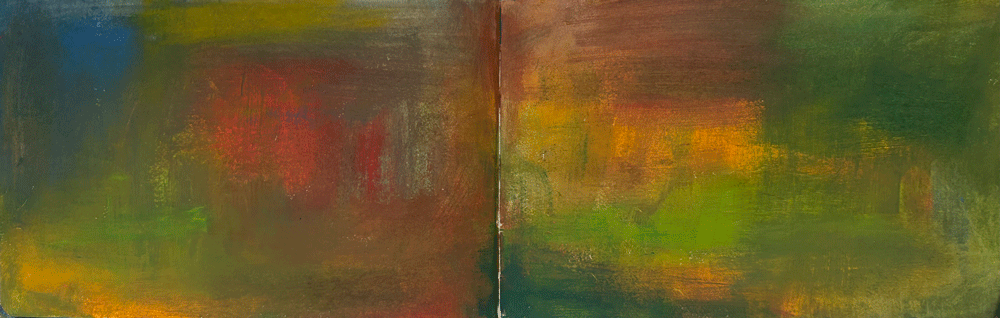
Artwork no. 29, from Cathryn Scarano’s article ‘The symbols of the therapist: Examining reoccurring motifs within clinical response art’.
Cathryn Scarano’s paper explores the subjective meanings associated with reoccurring visual motifs in response art using a novel method of data generation and analysis combining IPA, imaginal dialogue, and pursuit of the image. She includes tables presenting a dictionary of motifs within response art. The word associations as response to this artwork stood out as holding complexity – “Beautiful, chaotic, conflicting emotions, contained, empathy, leftover, lost, messy, overlaps, smooth, warm” (Scarano, 2026).
References
Atkins, S., & Eberhart, H. (2014). Presence and process in expressive arts work: At the edge of wonder. Jessica Kingsley.
Haraway, D.J. (2016). Staying with the trouble : Making kin in the Chthulucene. Duke University Press. https://doi.org/10.1515/9780822373780
Levine, S.K., & ProQuest. (2009). Trauma, tragedy, therapy the arts and human suffering. Jessica Kingsley.
Molbak, R.L. (2013). Cultivating the therapeutic moment: From planning to receptivity in therapeutic practice. The Journal of Humanistic Psychology, 53(4), 461–488. https://doi.org/10.1177/0022167812461305
Tervalon, M., & Murray-García, J. (1998). Cultural humility versus cultural competence: A critical distinction in defining physician training outcomes in multicultural education. Journal of Health Care for the Poor and Underserved, 9(2), 117–125. https://doi.org/10.1353/hpu.2010.0233