

Open Access
Published: December 2025
Licence: CC BY-NC-4.0
Issue: Vol.20, No.2
Word count: 807
About the author
Editorial – One candle
Sheridan Linnell, 15 December 2025
Many of the articles that comprise the second and final issue of JoCAT for 2025 are connected by the thread of continuous and creative learning, in and through the arts therapies.
A group of colleagues who teach in the Master of Art Therapy at LaTrobe, Tess Crane, Kate Richards, Pam Hellema, Carmen Millic and Sally Goldstraw, are the co-author participants in a carefully conceptualised exploratory enquiry into art therapy supervision in training inspired by the one canvas model. This practice paper is part of a broader Scholarship of Teaching and Learning (SoTL) research project that extends LaTrobe’s evidence-informed contributions to better understanding and shaping our practices as educators and therapists. The process in Crane et al. of layering and reworking diverse materials on one surface could equally be a guiding metaphor for this issue of JoCAT. Similarly, the questions the authors pose about identity and responsibility are specific to the ethics and practices of clinical supervision in arts therapy training yet resonate more widely.
Cite this editorialLinnell, S. (2025). Editorial: One candle. JoCAT, 20(2). https://www.jocat-online.org/e-25-linnell
Also in the tradition of SoTL and its growing contemporary emphasis on student well-being as intrinsic to learning, Ziyuan Lin and Nisara Jaroenkajornkij invited Thai undergraduate students to explore stressors and coping mechanisms through short-form video and written reflections and analysed the findings. They found that the video format enhanced emotional expression among the participating undergraduate students, with implications for its therapeutic application with other groups of young people experiencing distress.
University educators are more influential than they might suppose in shaping the pedagogical and social conditions of student well-being and learning (Bannigan et al., 2025). Moreover, the process of consulting students as partners and implementing their suggestions can, in itself, promote their sense of agency and inclusion as well as deepen our understanding as educators (Baik et al., 2019). With arts therapies scholars well-positioned to conduct such collaborative enquiries, we look forward to the next iterations of these important SoTL studies.
Meanwhile, in this issue of JoCAT, several arts therapists offer us a window into their training experiences through arts-based autoethnographies. Bursary recipient cat ko creates wonderfully poignant and pointed comics that chart the perils and promises of their development of an artist–therapist identity during their placement year. Samantha Neubronner navigates the complexity of holding space for Singaporean elders of the ‘pioneer generation’ as they approach death, in the profoundly formative experience of her final training placement. And senior Māori arts therapist Robyn Angell-Morice offers us an extraordinarily far-reaching account of her journey through Te Wheiao in the slow and illuminating dawning of a bicultural arts therapy identity.
Education and its interconnectedness with wellbeing and identity begin far earlier than university of course, in early childhood. Georgia Freebody’s invention of Therapeutic Art Play (TAP) takes arts therapy into and beyond early childhood settings. Freebody’s research ‘TAP’s into artworking as a material and relational process that honours the agency and wisdom of young children among the multiple co-creating agencies of materials, people and places.
RTM unfolds an arts-based autoethnographic, sensory and epistemological enquiry that centres neurodiversity, destabilising the power of neurotypical discourse in the creative arts therapies through serious and playful questioning. Susannah Morrison brings the neglected and highly significant life-threatening condition of sepsis vividly to our attention through a visceral and instructive account of her own survival. Junhaoran Li engages reflectively with Daoist philosophy to propose insights for arts therapy pedagogy, theory and practice “beyond words”. Mishy Rowan constructs a protective creative space in which to gently consider our precious relations with nature in the face of climate change.
The extension of the CATs into other domains of enquiry also typifies the reviews that round out this issue of JoCAT, which variously canvas books and exhibitions in order to tempt and enrich the repertoire of experiences vicariously available to JoCAT readers and listeners.
Finally, a group of early career art therapists who trained together at Western Sydney University, Ko, Law and Cheung – although I want to affectionately call them cat, Coco and Clara – quickly mobilised to support the Sydney-based Hong Kong community after the Tai Po fire. Their passion, responsiveness, care, and collegiality alongside other Hongkongers making a statement through art, are caught in a short and eloquent piece for JoCAT. As the paper cranes of long life fly back to Hong Kong, this generation of creative art therapists gives us hope.
And, as I conclude writing this brief editorial the day after the massacre at Bondi Beach of people celebrating the beginning of Hannukah, hope is sorely needed.
Australians have been asked to light a candle and place it in our front windows this evening.
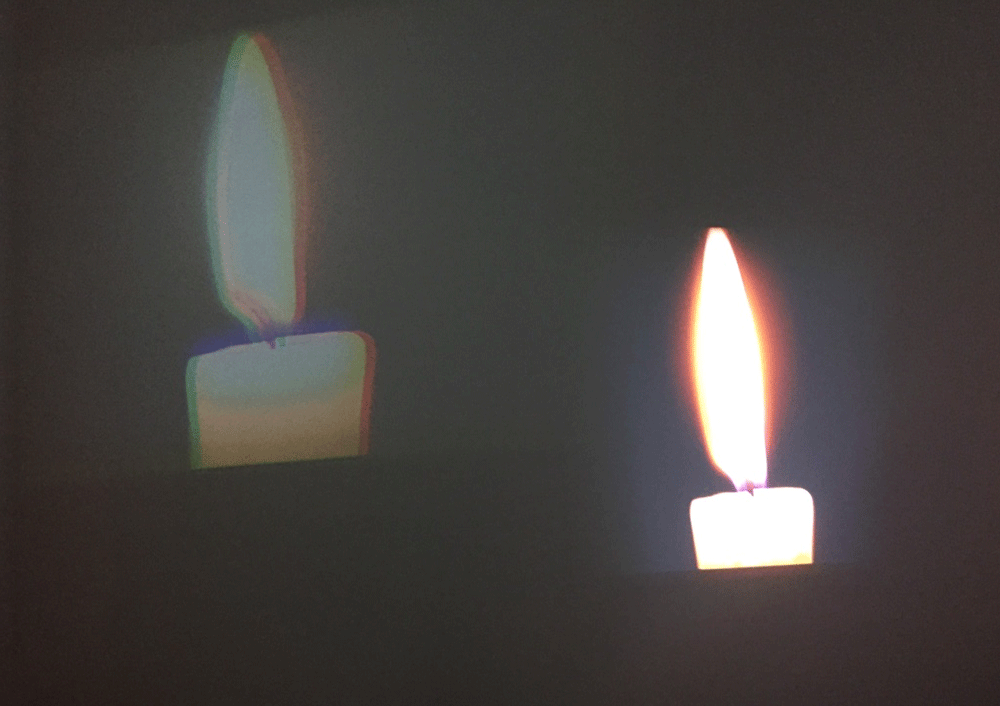
Nam June Paik, One Candle (Candle Projection), 1989, video projection (detail), digital photograph by Sheridan Linnell, Tate Modern, November 2019.
Note: The place name ‘Bondi’ is derived from a Dharawal word meaning ‘loud thud’, such as the sound of waves breaking over rocks.
References
Baik, C., Larcombe, W., & Brooker, A. (2019). How universities can enhance student mental wellbeing: The student perspective. Higher Education Research & Development, 38(4), 674–687. https://doi.org/10.1080/07294360.2019.1576596
Bannigan, G., McGrath, D., & Matthews, J. (2025). Whole-university approaches to embedding well-being in the curriculum: A scoping review. Frontiers in Education (Lausanne), 10. https://doi.org/10.3389/feduc.2025.1534244